
 Image 1 of 1
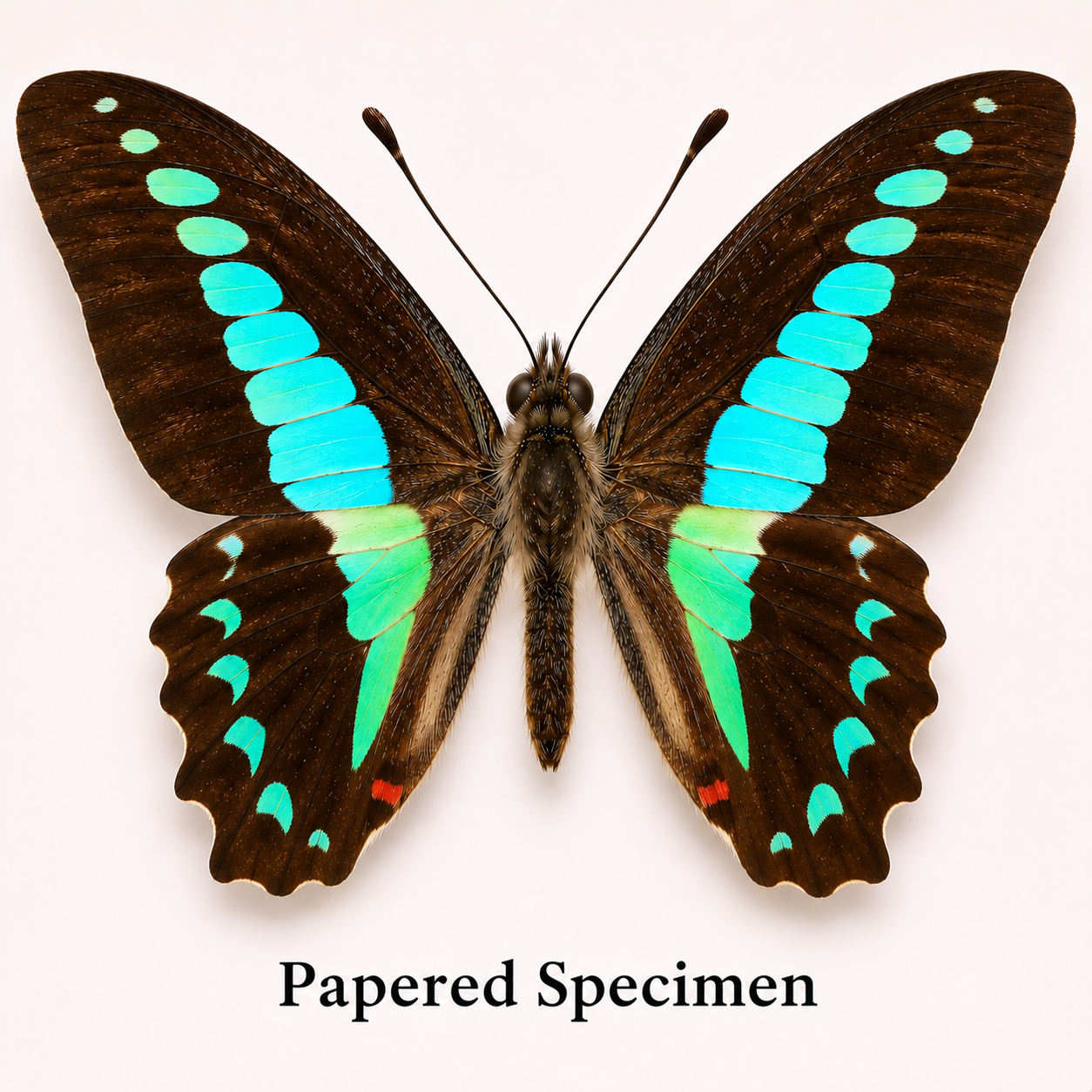
The Common Bluebottle (Graphium sarpedon) is a striking butterfly recognized for its brilliant turquoise-blue to greenish-blue bands that extend across its dark brown to black wings. The undersides feature similar blue-green markings accented by small red spots near the hindwings. With a wingspan of approximately 2 to 3 inches, this member of the Papilionidae family is known for its vivid coloration and remarkably fast, agile flight, making it one of the most recognizable swallowtail butterflies of tropical Asia.
Native to South and Southeast Asia, East Asia, and parts of Australia, Graphium sarpedon is widely distributed throughout India, China, Japan, Thailand, Malaysia, Indonesia, and other surrounding regions. It inhabits tropical and subtropical forests, woodland edges, gardens, parks, and areas near streams. Its caterpillars feed primarily on plants in the laurel family (Lauraceae), including camphor trees (Cinnamomum camphora), cinnamon trees, and various Litsea species. Adults frequently visit flowering plants for nectar.
Interesting Fact:
The Common Bluebottle is famous for its exceptionally rapid flight, often darting through forest clearings and along streams with remarkable speed and agility. Males frequently gather in groups on damp soil, muddy streambanks, and wet sand to absorb dissolved minerals, particularly sodium, in a behavior known as mud-puddling. These minerals are important for reproduction and may be transferred to females during mating. Despite its brilliant coloration, this butterfly can be surprisingly difficult to follow in flight because of its speed and sudden changes in direction.
This specimen is preserved and is carefully stored in a protective paper triangle, ensuring it arrives safely and is ready for spreading or long-term collection. Collection data is included.
All specimens are ethically sourced, collected responsibly with a focus on sustainability and minimal impact on wild populations.
Image is a representation drawing and is not scientifically accurate.