
 Image 1 of 1
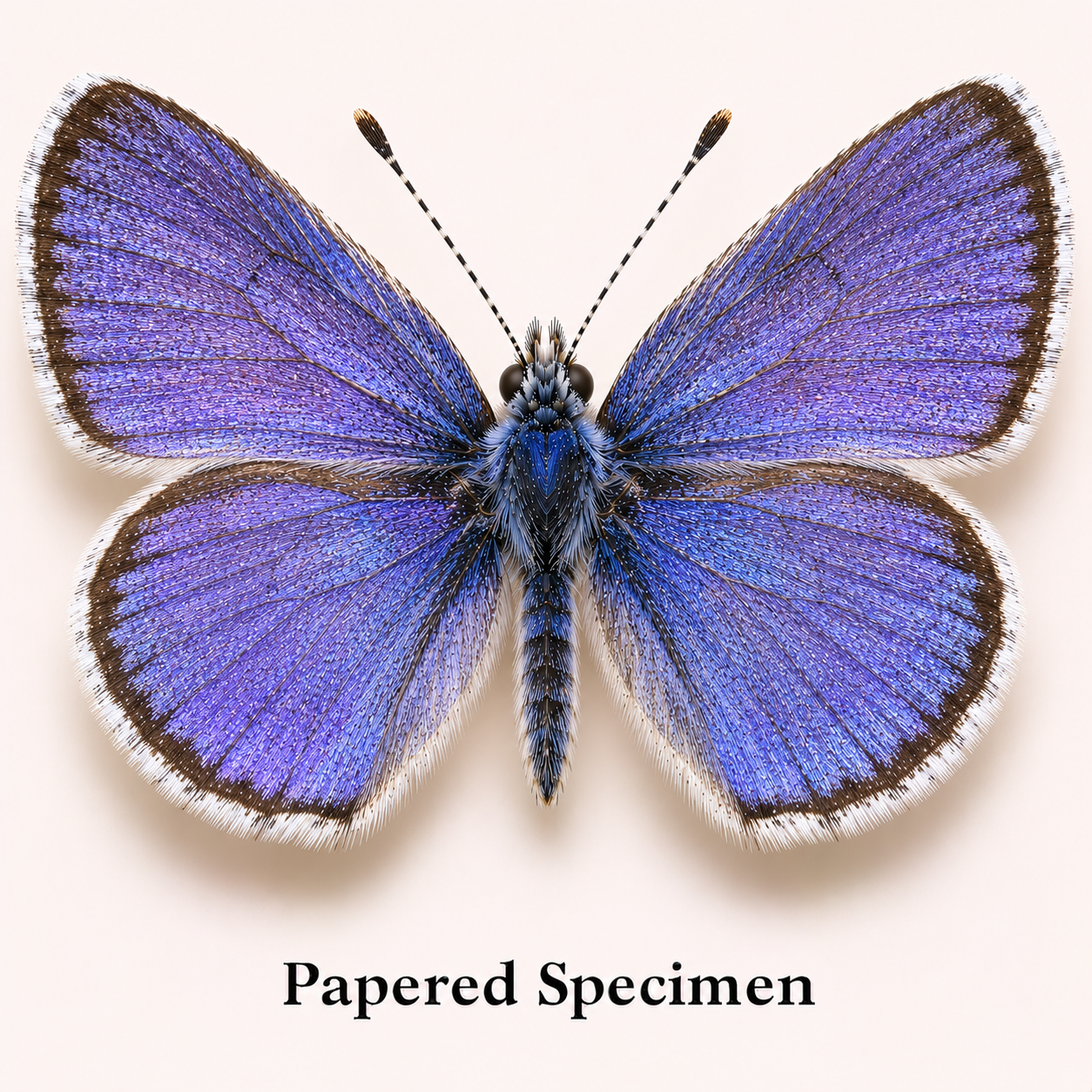
Anna’s Blue (Plebejus anna) is a beautiful North American butterfly recognized for its shimmering violet-blue wings and delicate orange and black markings. Males display brilliant violet-blue upper wings bordered by narrow black margins and white fringes, while females are predominantly brown with orange crescents along the outer wing margins. The undersides are pale bluish-gray with small black spots and a distinctive row of orange markings accented by iridescent blue scales. With a wingspan of approximately 1 to 1¼ inches, this member of the Lycaenidae family is a striking representative of western North America’s blue butterflies.
Native to western North America, Plebejus anna occurs from southern British Columbia through the Cascade Mountains and Sierra Nevada of Washington, Oregon, and California. It inhabits cool mountain meadows, forest clearings, open coniferous woodlands, and grassy slopes, frequently at elevations above 3,000 feet. Its caterpillars feed primarily on plants in the legume family (Fabaceae), particularly lupines (Lupinus spp.), milkvetches (Astragalus spp.), and bird’s-foot trefoils (Hosackia spp.). Adults visit mountain wildflowers for nectar and are most frequently encountered during summer.
Interesting Fact:
Anna’s Blue is particularly fascinating because of its close resemblance to several other North American blue butterflies. It is especially similar to the Northern Blue (Plebejus idas), and some individuals can be extremely difficult to distinguish by appearance alone. One useful identification feature is the orange markings along the upper wing margins of females, which may extend onto both the forewings and hindwings. Interestingly, the species was originally described by William Henry Edwards in 1861, with its type locality recorded near Truckee in Nevada County, California. In Oregon, adults can be observed from early June into October, depending on elevation and weather conditions.
This specimen is preserved and is carefully stored in a protective paper triangle, ensuring it arrives safely and is ready for spreading or long-term collection. Collection data is included.
All specimens are ethically sourced, collected responsibly with a focus on sustainability and minimal impact on wild populations.
Image is a representation drawing and is not scientifically accurate.