
 Image 1 of 1
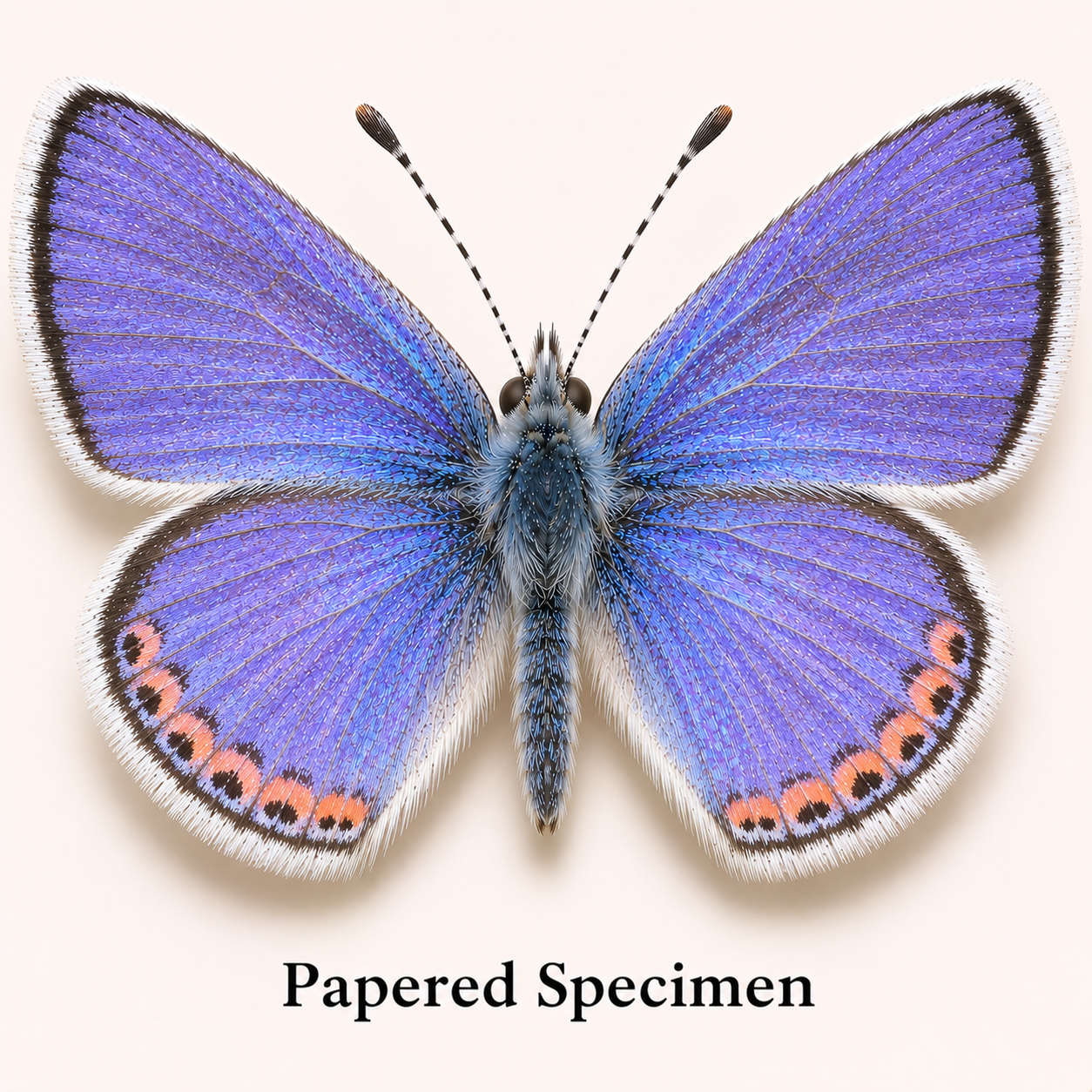
The Lupine Blue (Icaricia lupini) is a beautiful North American butterfly recognized for its delicate iridescent blue wings and distinctive orange markings. Males typically display brilliant violet-blue to silvery-blue upper wings with narrow dark borders and a row of orange-red spots along the hindwing margins, while females are generally brown with varying amounts of blue coloration. The undersides are pale bluish-gray with rows of black spots surrounded by white rings and a distinctive orange band accented by metallic blue-green scales. With a wingspan of approximately ⅞ to 1⅛ inches, this member of the Lycaenidae family is a striking example of the small blue butterflies found throughout western North America.
Native to western North America, Icaricia lupini ranges from southwestern Canada through the western United States and into northern Mexico. It inhabits mountain meadows, sagebrush habitats, chaparral, rocky slopes, grasslands, and open woodlands. Its caterpillars feed primarily on perennial wild buckwheats (Eriogonum spp.), particularly sulfur buckwheat (Eriogonum umbellatum) and California buckwheat (Eriogonum fasciculatum). Adults visit various wildflowers for nectar and are often observed near their caterpillar host plants.
Interesting Fact:
Despite its common name, the Lupine Blue does not normally feed on lupines. Instead, its caterpillars specialize in wild buckwheats, making the name somewhat misleading. This species closely resembles the Acmon Blue (Icaricia acmon), but can often be distinguished by its slightly larger size, brighter blue coloration, and distinctive dark border separating the orange hindwing markings from the blue upper wings. Lupine Blue caterpillars also have relationships with ants, which tend the larvae in exchange for sugary secretions. In the Sierra Nevada, this butterfly typically produces only one generation annually, with adults appearing during the summer months.
This specimen is preserved and is carefully stored in a protective paper triangle, ensuring it arrives safely and is ready for spreading or long-term collection. Collection data is included.
All specimens are ethically sourced, collected responsibly with a focus on sustainability and minimal impact on wild populations.
Image is a representation drawing and is not scientifically accurate.