
 Image 1 of 1
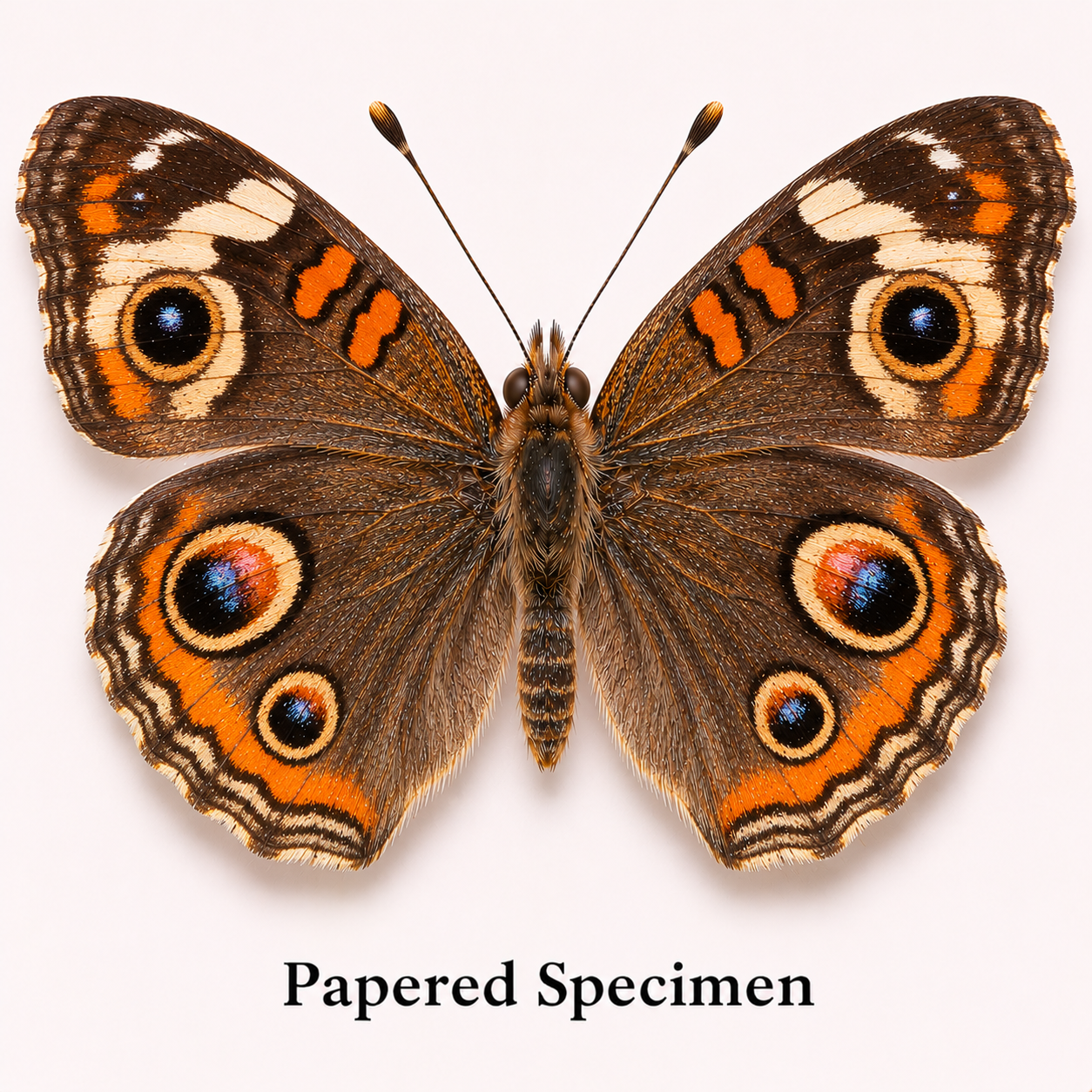
The Common Buckeye (Junonia coenia) is a striking North American butterfly recognized for its distinctive eyespots and intricate wing patterns. Its rich brown wings feature bold orange bands, cream-colored markings, and large circular eyespots accented with black, blue, and purple. The undersides are more subdued, ranging from tan to reddish-brown, providing effective camouflage when the wings are closed. With a wingspan of approximately 1⅝ to 2¾ inches, this member of the Nymphalidae family is one of the most recognizable butterflies found throughout North America.
Native to North America, Junonia coenia is widely distributed throughout the United States, Mexico, and parts of southern Canada. It inhabits open grasslands, meadows, roadsides, gardens, coastal dunes, and other sunny environments with low-growing vegetation. Its caterpillars feed on plants in several families, particularly plantains (Plantago spp.), snapdragons (Antirrhinum spp.), and wild petunias (Ruellia spp.). Adults visit a variety of wildflowers for nectar, including asters, chicory, and other flowering plants.
Interesting Fact:
The Common Buckeye gets its name from the large, colorful eyespots on its wings, which are believed to help discourage predators by resembling the eyes of a much larger animal. This species also displays remarkable seasonal variation in coloration, with summer individuals typically having tan or brown hindwing undersides, while autumn individuals often develop rich reddish tones. Common Buckeyes are strong seasonal dispersers, expanding northward during warmer months before retreating south as temperatures decline. Males are highly territorial and frequently perch on bare ground or low vegetation, chasing away other butterflies that enter their territory.
This specimen is preserved and is carefully stored in a protective paper triangle, ensuring it arrives safely and is ready for spreading or long-term collection. Collection data is included.
All specimens are ethically sourced, collected responsibly with a focus on sustainability and minimal impact on wild populations.
Image is a representation drawing and is not scientifically accurate.