
 Image 1 of 1
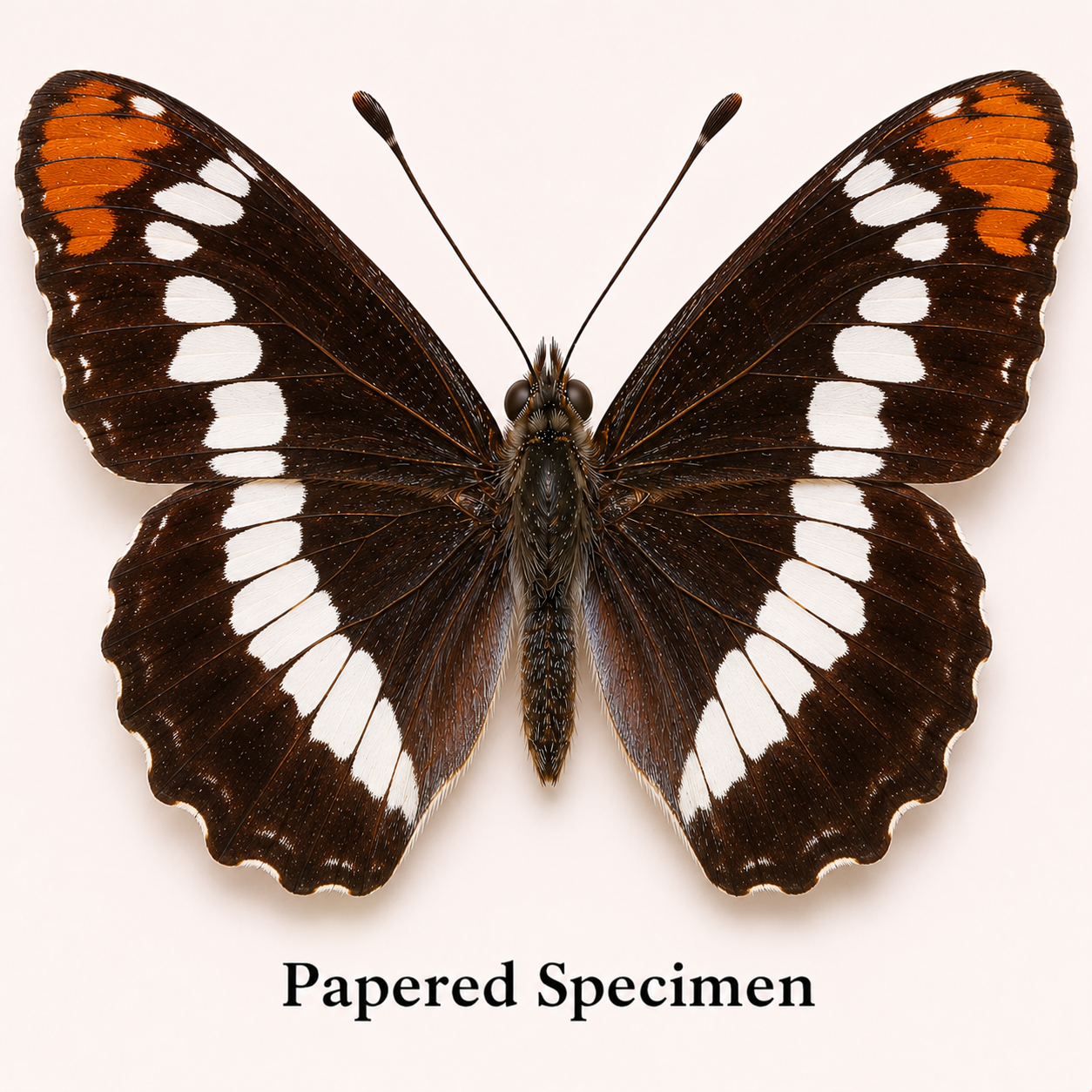
The Lorquin’s Admiral (Limenitis lorquini) is a striking North American butterfly recognized for its dramatic dark brown to black wings crossed by bold white bands and accented with distinctive orange-brown patches near the forewing tips. The undersides display a beautiful combination of reddish-brown, white, and dark markings, often with subtle violet highlights. With a wingspan of approximately 2 to 2⅝ inches, this member of the Nymphalidae family is one of the most recognizable butterflies of western North America’s woodland and riparian habitats.
Native to western North America, Limenitis lorquini ranges from southern British Columbia through Washington, Oregon, and California into Baja California, extending eastward into parts of Montana and Idaho. It inhabits riparian woodlands, forest edges, mountain canyons, stream corridors, and areas with abundant deciduous trees. Its caterpillars feed primarily on willows (Salix spp.), cottonwoods and poplars (Populus spp.), and wild cherries (Prunus spp.). Adults visit a variety of flowering plants, including California buckeye (Aesculus californica), buttonbush (Cephalanthus occidentalis), and yerba santa (Eriodictyon spp.).
Interesting Fact:
Lorquin’s Admiral is believed to mimic the California Sister (Adelpha californica), a butterfly that predators may avoid because of its chemical defenses. Its bold white wing bands and dark coloration create a similar appearance, potentially offering protection from predators. Male Lorquin’s Admirals are highly territorial, frequently perching along streams and forest openings while aggressively pursuing other butterflies that enter their territory. The caterpillars also possess remarkable camouflage, resembling bird droppings during their development. Partially grown caterpillars survive the winter inside protective shelters constructed from rolled leaves.
This specimen is preserved and is carefully stored in a protective paper triangle, ensuring it arrives safely and is ready for spreading or long-term collection. Collection data is included.
All specimens are ethically sourced, collected responsibly with a focus on sustainability and minimal impact on wild populations.
Image is a representation drawing and is not scientifically accurate.