
 Image 1 of 1
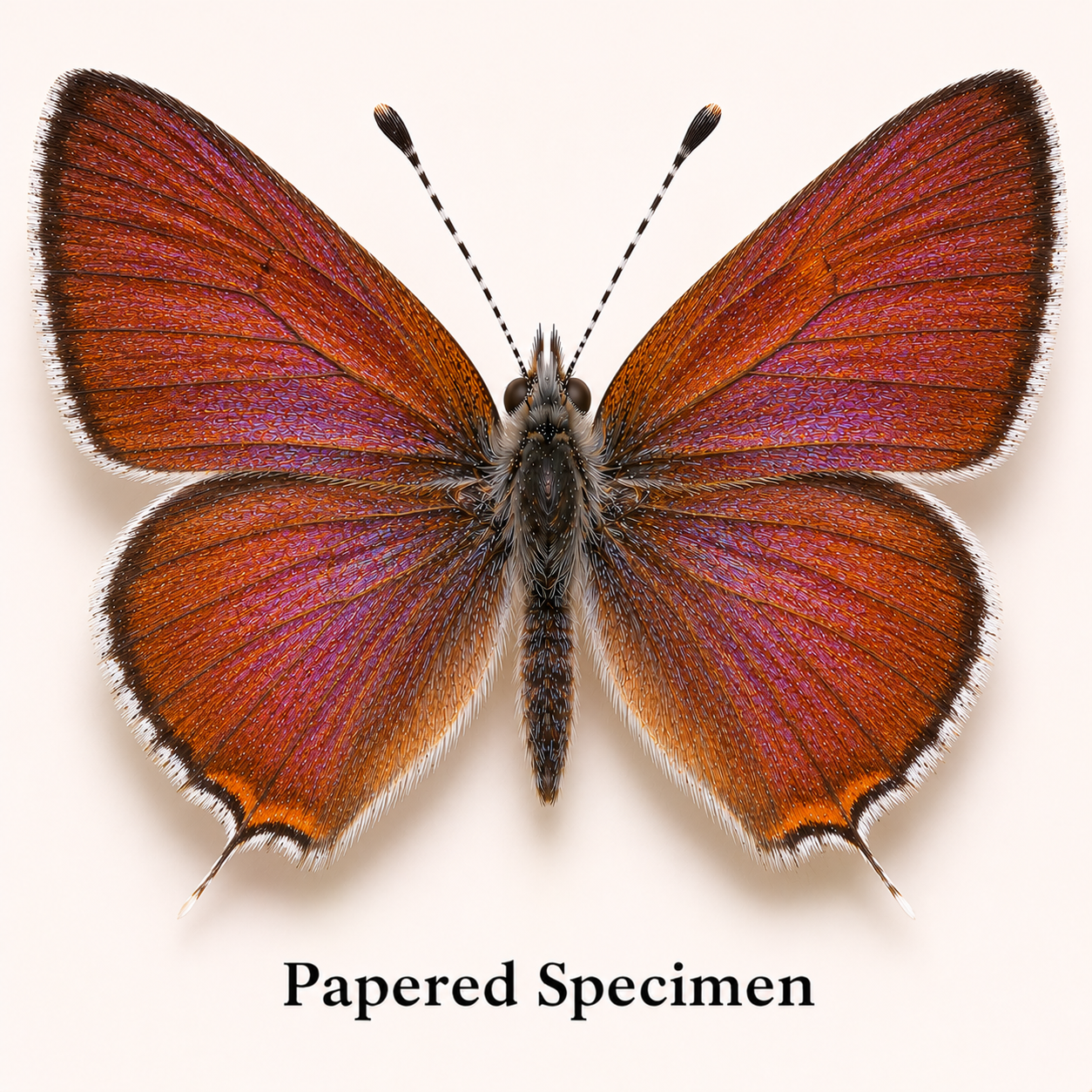
The Tailed Copper (Lycaena arota) is a beautiful North American butterfly recognized for its rich copper-brown wings, distinctive markings, and delicate tail-like extensions on its hindwings. Males typically display coppery-brown upper wings with a subtle iridescent purple sheen, while females feature striking orange and dark brown patterns. The undersides are grayish-brown with black spots, irregular white markings, and pale crescent-shaped bands near the wing margins. With a wingspan of approximately 1⅛ to 1⅜ inches, this member of the Lycaenidae family is unusual among North American copper butterflies because of its slender hindwing tails.
Native to western North America, Lycaena arota ranges from Oregon through California and neighboring western states, extending south into Baja California and east to New Mexico. It inhabits open woodlands, mountain canyons, chaparral, sagebrush habitats, and riparian corridors. Its caterpillars feed primarily on currants and gooseberries (Ribes spp.), consuming their leaves during spring and early summer. Adults visit various wildflowers for nectar, particularly wild buckwheats (Eriogonum spp.) and asters.
Interesting Fact:
Unlike most North American copper butterflies, the Tailed Copper possesses a delicate, threadlike extension on each hindwing, giving the species its distinctive common name. Males frequently perch on shrubs and branches in sunny woodland openings, watching for passing females. Another fascinating characteristic is its overwintering strategy: females lay individual eggs on or near currant and gooseberry plants, and the eggs remain dormant throughout winter before hatching the following spring. This species produces only one generation annually, with adults typically appearing from late spring through summer.
This specimen is preserved and is carefully stored in a protective paper triangle, ensuring it arrives safely and is ready for spreading or long-term collection. Collection data is included.
All specimens are ethically sourced, collected responsibly with a focus on sustainability and minimal impact on wild populations.
Image is a representation drawing and is not scientifically accurate.