
 Image 1 of 1
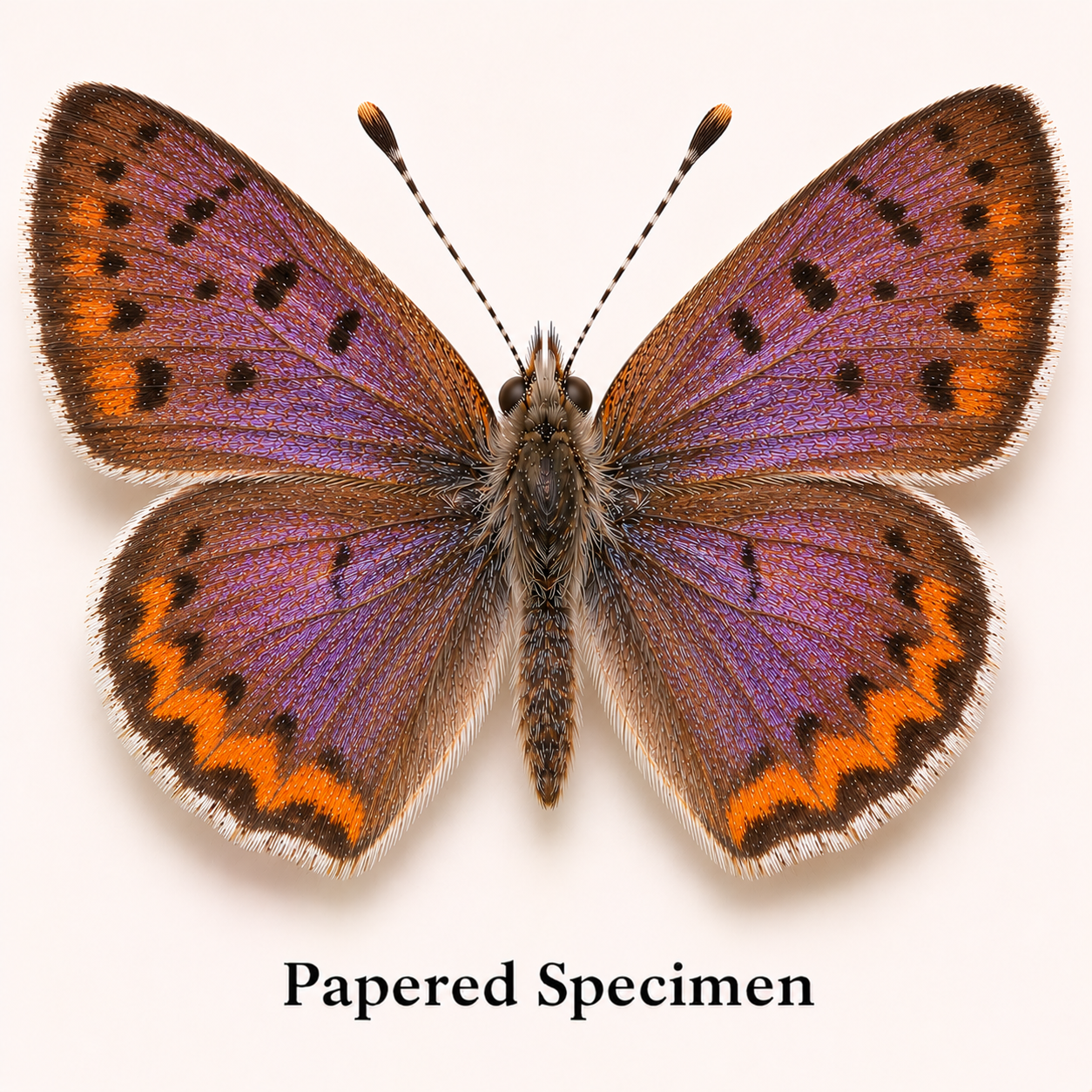
The Purplish Copper (Lycaena helloides) is a beautiful North American butterfly recognized for its distinctive copper-orange coloration and shimmering purple iridescence. Males typically display dark brown upper wings with a brilliant purplish sheen, while females have brighter orange wings accented by prominent black spots. Both sexes feature a distinctive orange band along the outer margins of their hindwings. The undersides are pale grayish-brown with numerous small black spots and delicate orange markings. With a wingspan of approximately 1⅛ to 1½ inches, this member of the Lycaenidae family is one of the most attractive copper butterflies found throughout North America.
Native to North America, Lycaena helloides ranges from the Great Lakes region across the northern United States and southern Canada to the Pacific Coast, extending south into Baja California. It inhabits wet meadows, marshes, stream corridors, grasslands, roadsides, and other open environments with abundant vegetation. Its caterpillars feed primarily on plants in the buckwheat family (Polygonaceae), particularly docks (Rumex spp.) and knotweeds (Polygonum spp.), as well as certain cinquefoils (Potentilla spp.). Adults visit various wildflowers for nectar, including asters, alfalfa, and goldenrods.
Interesting Fact:
The Purplish Copper gets its name from the remarkable violet-purple iridescence displayed by males, which is especially noticeable in freshly emerged butterflies. Unlike many butterfly species that attach their eggs directly to host plant leaves, female Purplish Coppers frequently scatter their eggs near the bases of host plants or among surrounding leaf litter. The eggs remain dormant throughout winter, hatching when favorable conditions return in spring. This species can produce several generations annually, with adults sometimes remaining active into late autumn. Interestingly, although it was once common in California’s Sacramento Valley, its populations have declined considerably in many low-elevation areas.
This specimen is preserved and is carefully stored in a protective paper triangle, ensuring it arrives safely and is ready for spreading or long-term collection. Collection data is included.
All specimens are ethically sourced, collected responsibly with a focus on sustainability and minimal impact on wild populations.
Image is a representation drawing and is not scientifically accurate.