
 Image 1 of 1
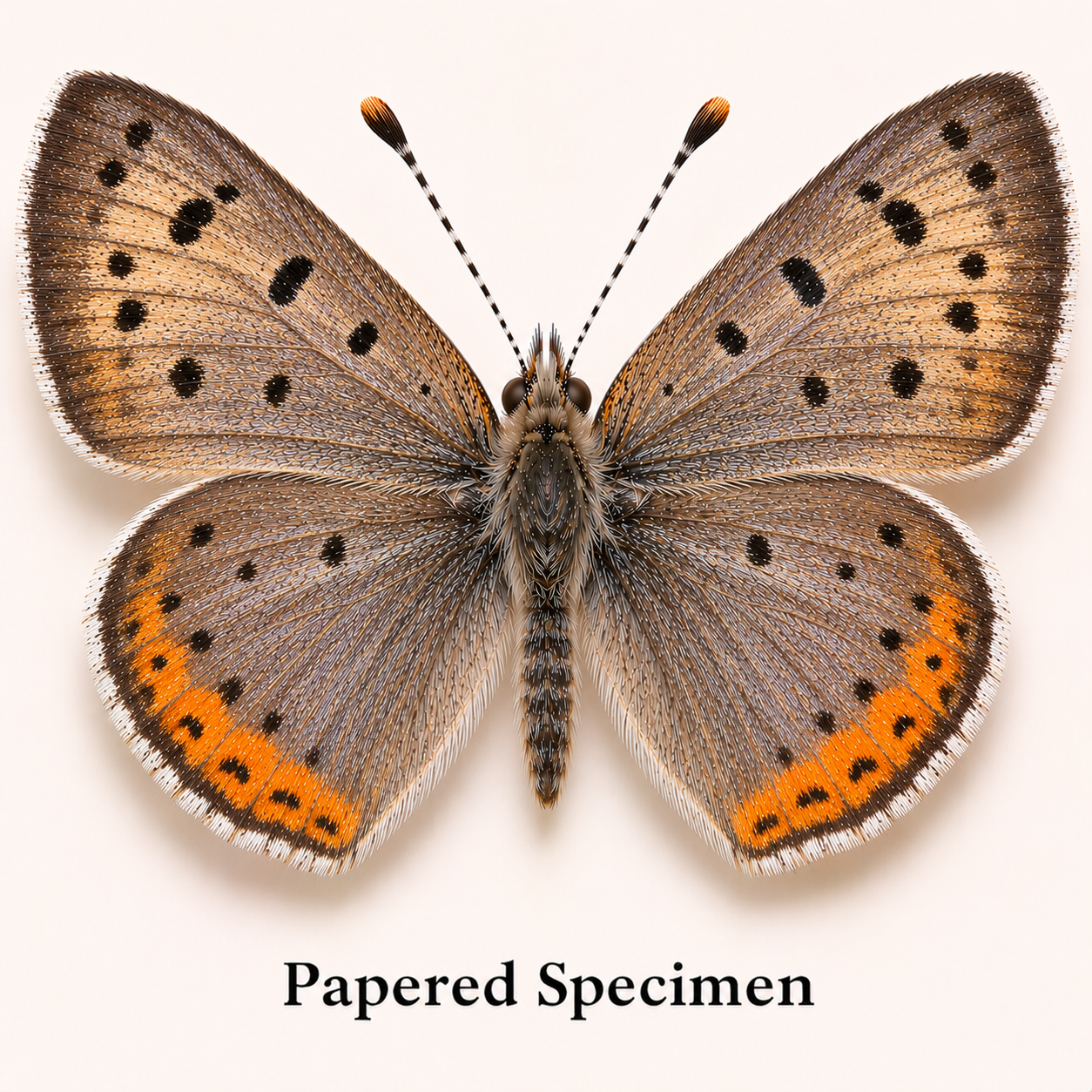
The Great Copper (Lycaena xanthoides) is a beautiful North American butterfly recognized for its distinctive grayish-brown wings, intricate black markings, and contrasting orange accents. Males typically display muted gray-brown upper wings with small dark spots and subtle orange markings along the hindwing margins, while females feature more prominent black spots, tan patches, and bright orange crescents. The undersides are pale grayish-brown with numerous black spots, a contrasting whitish band, and delicate orange markings near the hindwing edges. With a wingspan of approximately 1¼ to 1¾ inches, this member of the Lycaenidae family is one of the largest copper butterflies found in western North America.
Native to western North America, Lycaena xanthoides ranges from southern Oregon through California and into northern Baja California. It inhabits open grasslands, foothill meadows, valleys, wetland margins, and grassy hillsides. Its caterpillars feed primarily on docks (Rumex spp.), particularly curly dock (Rumex crispus), which commonly grows in disturbed grasslands and moist environments. Adults visit a variety of wildflowers for nectar, including gumplants (Grindelia spp.), dogbane (Apocynum cannabinum), and horehound (Marrubium vulgare).
Interesting Fact:
The Great Copper is notable for its unusually large size compared with other North American copper butterflies. Unlike species that produce several generations annually, Great Coppers typically have only one generation each year. Females lay their eggs on or near dock plants, where the eggs remain dormant throughout winter before hatching the following spring. Males are highly territorial, frequently perching close to the ground and engaging in spectacular aerial chases when other butterflies enter their territory. Remarkably, mark-recapture studies in California suggest that some individuals may survive for at least a month as adults, an impressive lifespan for a small butterfly.
This specimen is preserved and is carefully stored in a protective paper triangle, ensuring it arrives safely and is ready for spreading or long-term collection. Collection data is included.
All specimens are ethically sourced, collected responsibly with a focus on sustainability and minimal impact on wild populations.
Image is a representation drawing and is not scientifically accurate.