
 Image 1 of 1
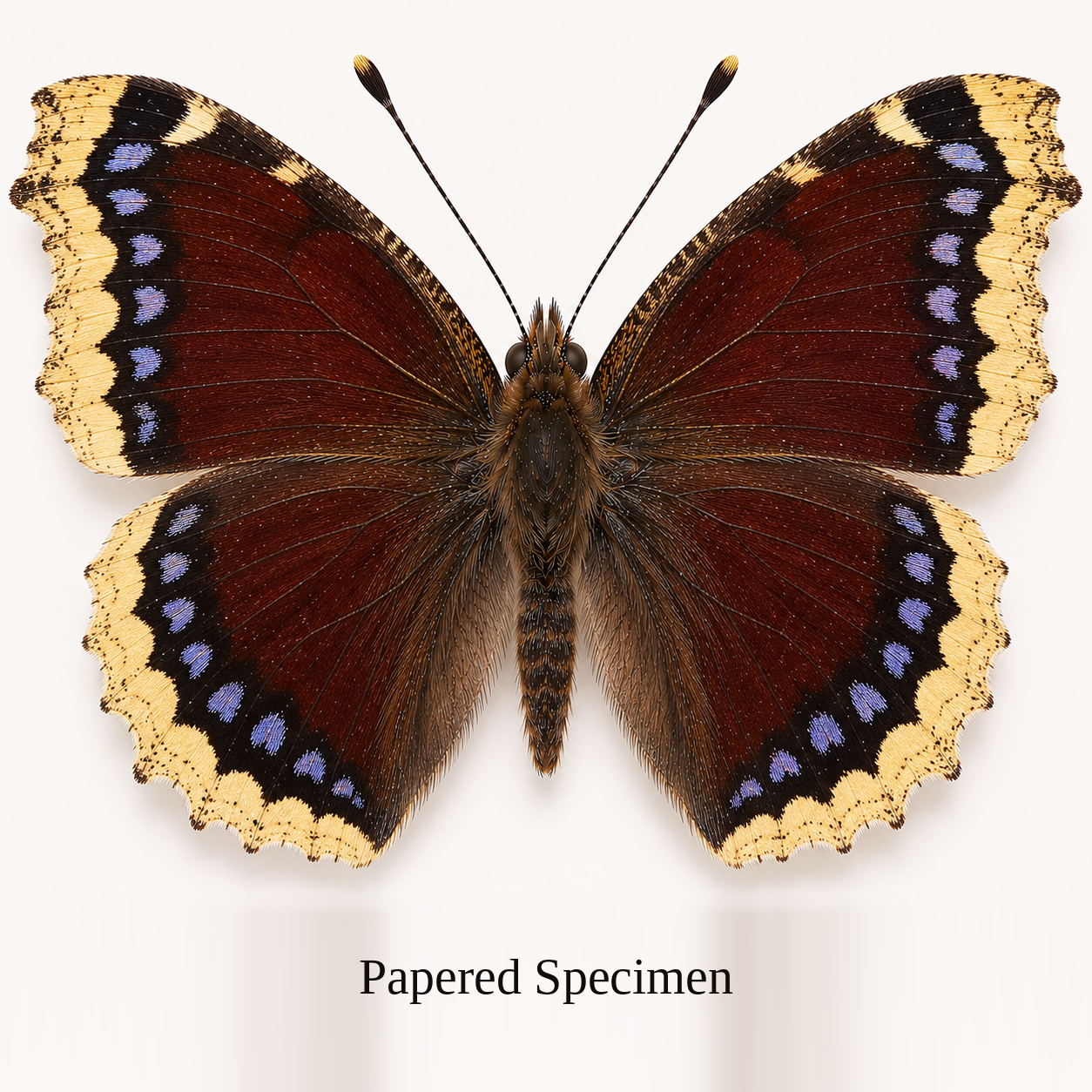
The Mourning Cloak (Nymphalis antiopa) is a striking North American butterfly recognized for its deep maroon-brown wings bordered by a broad band of creamy yellow and a distinctive row of brilliant iridescent blue spots. Its velvety upper wings contrast dramatically with the dark grayish-black undersides, which feature intricate, bark-like patterns that provide excellent camouflage. With a wingspan of approximately 2¼ to 4 inches, this member of the Nymphalidae family is one of the most recognizable butterflies found throughout temperate regions of the Northern Hemisphere.
Native to North America, Europe, and Asia, Nymphalis antiopa is widely distributed from Alaska and Canada through much of the United States and into central Mexico, as well as throughout temperate Eurasia. It inhabits deciduous woodlands, riparian corridors, forest edges, parks, gardens, and mountain canyons. Its caterpillars feed primarily on willows (Salix spp.), cottonwoods and poplars (Populus spp.), elms (Ulmus spp.), and birches (Betula spp.). Adults frequently feed on tree sap, rotting fruit, and other sources of dissolved nutrients rather than relying primarily on flower nectar.
Interesting Fact:
The Mourning Cloak is one of the longest-lived butterflies in the world, with adults capable of surviving approximately 10 to 11 months. Unlike most butterflies that overwinter as eggs, caterpillars, or chrysalises, Mourning Cloaks survive the winter as fully developed adults, sheltering beneath loose bark, inside hollow trees, and in other protected locations. This remarkable adaptation allows them to emerge on warm days in late winter and early spring, often before the first wildflowers bloom. Females lay their eggs in large clusters encircling host plant twigs, and the distinctive black, red-spotted caterpillars feed together in groups. In Britain, this butterfly is known as the Camberwell Beauty.
This specimen is preserved and is carefully stored in a protective paper triangle, ensuring it arrives safely and is ready for spreading or long-term collection. Collection data is included.
All specimens are ethically sourced, collected responsibly with a focus on sustainability and minimal impact on wild populations.
Image is a representation drawing and is not scientifically accurate.