
 Image 1 of 1
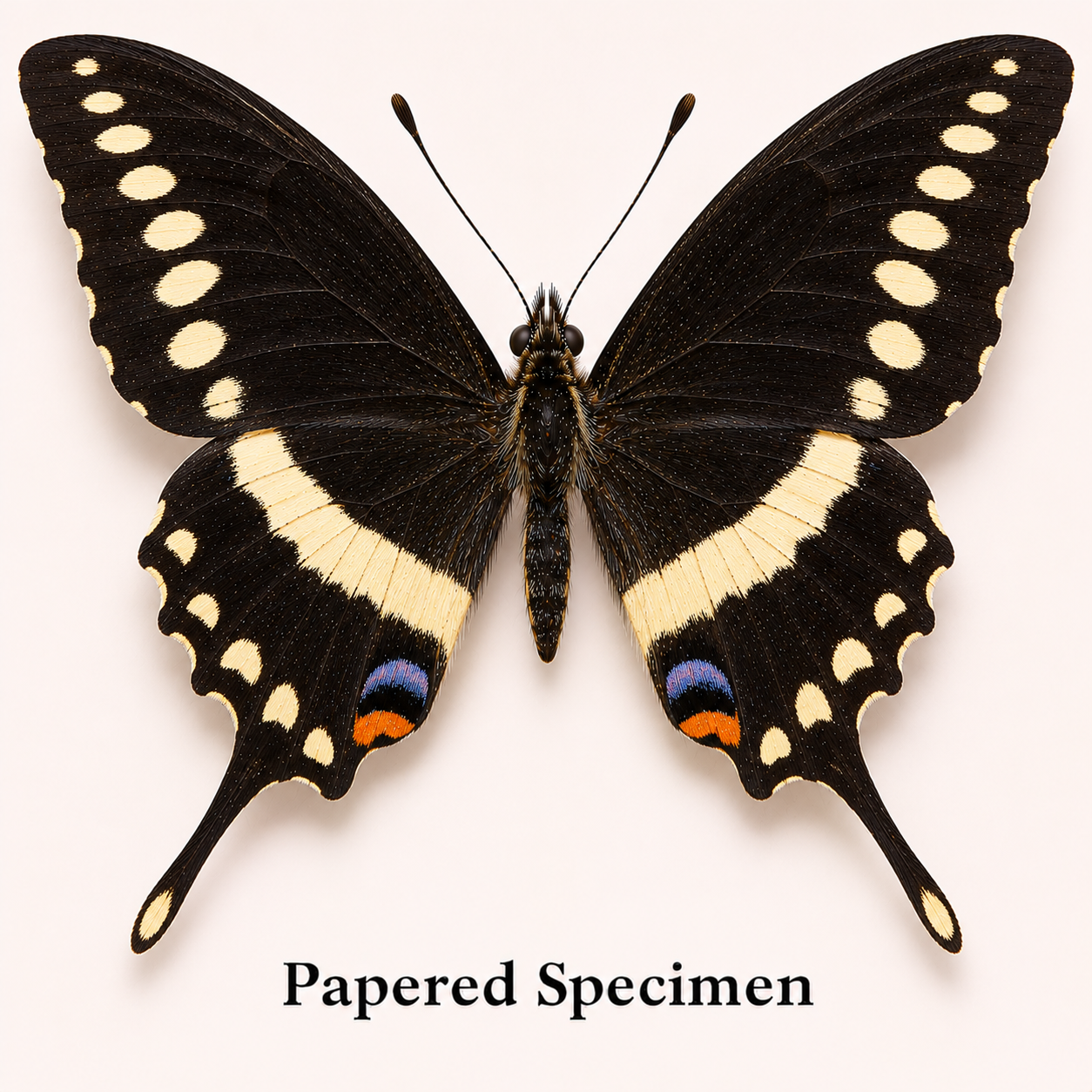
The Central Emperor Swallowtail (Papilio lormieri) is a magnificent African butterfly recognized for its dramatic black wings crossed by elegant pale yellow bands and accented with colorful markings. Its large forewings feature creamy-yellow spots and narrow bands, while the hindwings display long, slender tails and striking blue and orange eyespots. The undersides reveal additional intricate blue and orange patterns that contrast beautifully with the dark background. With a wingspan of approximately 4 to 5 inches, this member of the Papilionidae family is one of the most impressive swallowtail butterflies found in the tropical forests of Africa.
Native to central and western Africa, Papilio lormieri occurs in countries including Cameroon, Gabon, the Democratic Republic of the Congo, Angola, Uganda, and western Kenya. It inhabits tropical forests, forest clearings, and wooded environments, particularly in areas with abundant vegetation. Its caterpillars feed on plants in the citrus family (Rutaceae), including Clausena anisata, Fagaropsis species, and various Zanthoxylum and Teclea species. Adults visit flowering plants for nectar.
Interesting Fact:
The Central Emperor Swallowtail belongs to a group of closely related African emperor swallowtails distinguished by their impressive size, elongated tails, and intricate wing markings. Its pale yellow bands and brilliant blue and orange hindwing markings help distinguish it from related species. Interestingly, when Papilio lormieri was first scientifically described in 1874, its original locality was incorrectly recorded as Madagascar, even though the species is native to mainland Africa. Like other swallowtails, its caterpillars possess a specialized defensive organ called an osmeterium, which can release unpleasant-smelling chemicals when threatened.
This specimen is preserved and is carefully stored in a protective paper triangle, ensuring it arrives safely and is ready for spreading or long-term collection. Collection data is included.
All specimens are ethically sourced, collected responsibly with a focus on sustainability and minimal impact on wild populations.
Image is a representation drawing and is not scientifically accurate.