
 Image 1 of 1
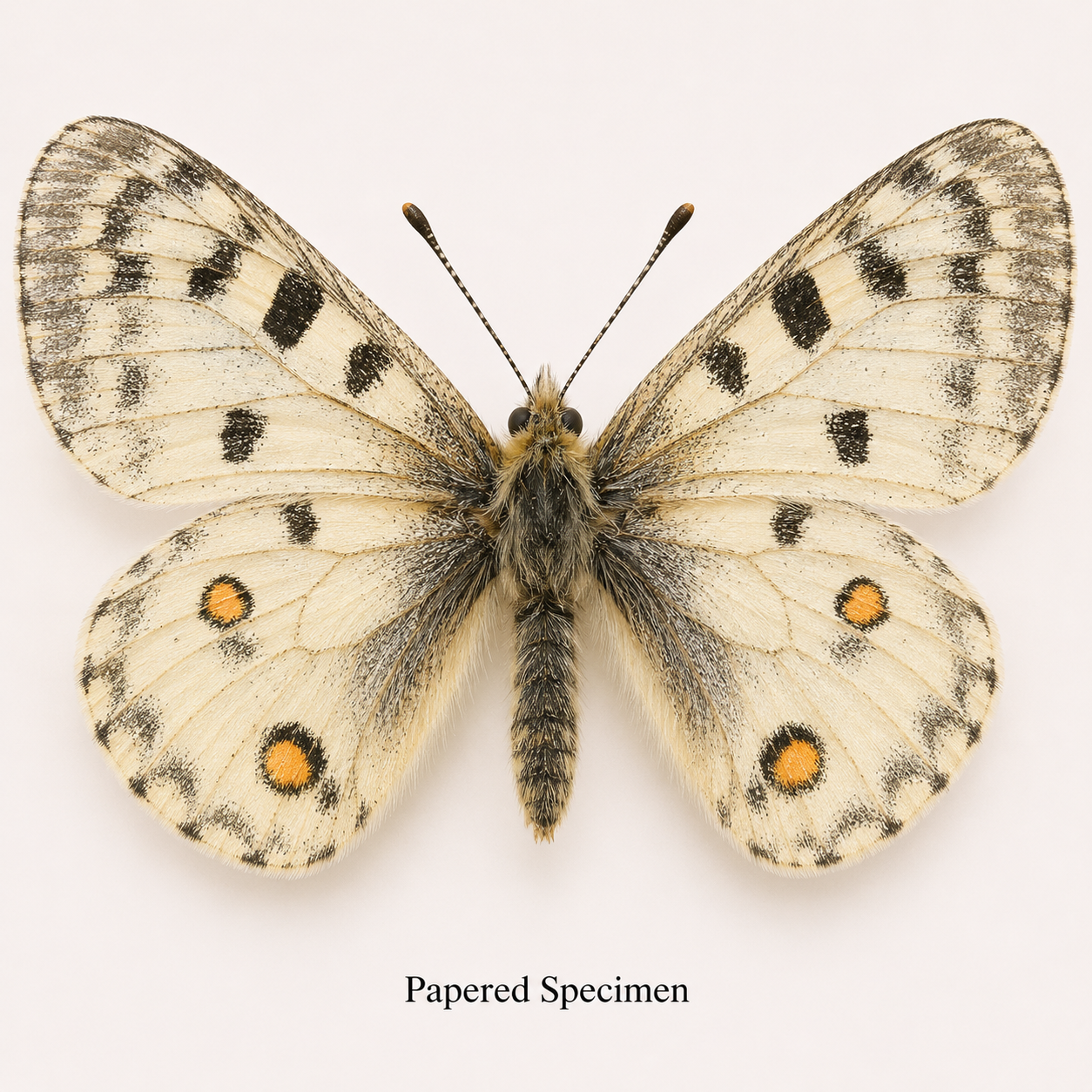
The Clodius Parnassian (Parnassius clodius) is a beautiful North American butterfly recognized for its delicate, translucent white wings accented by distinctive black and gray markings and brilliant red eyespots. Its forewings feature three prominent dark gray bands, while the hindwings display two striking red spots surrounded by black rings. The wing margins are partially transparent, creating an elegant, almost glasslike appearance. With a wingspan of approximately 2 to 2½ inches, this member of the Papilionidae family is one of the most distinctive butterflies found in western North America’s mountain habitats.
Native to western North America, Parnassius clodius ranges from southern British Columbia and Alberta through the western United States, including California, Oregon, Washington, Montana, Wyoming, and Utah. It inhabits mountain meadows, open coniferous forests, rocky slopes, forest clearings, and moist woodland environments. Its caterpillars feed primarily on bleeding hearts (Dicentra spp.), including Pacific bleeding heart (Dicentra formosa), steer’s head (Dicentra uniflora), and few-flowered bleeding heart (Dicentra pauciflora). Adults visit various wildflowers for nectar, including wild buckwheats, yerba santa, and coyote mint.
Interesting Fact:
The Clodius Parnassian has a fascinating reproductive adaptation. After mating, males produce a specialized waxy structure called a sphragis, which attaches to the female’s abdomen and helps prevent additional matings. This unusual structure is especially prominent in Parnassian butterflies and can remain attached throughout the female’s life. Another distinctive feature is the species’ nearly solid black antennae, which help distinguish it from the similar Rocky Mountain Parnassian (Parnassius smintheus), whose antennae have alternating black and white bands. Clodius Parnassians typically produce only one generation annually, with adults appearing during late spring and summer depending on elevation. The species survives winter in the egg stage, with caterpillars emerging when conditions become favorable in spring.
This specimen is preserved and is carefully stored in a protective paper triangle, ensuring it arrives safely and is ready for spreading or long-term collection. Collection data is included.
All specimens are ethically sourced, collected responsibly with a focus on sustainability and minimal impact on wild populations.
Image is a representation drawing and is not scientifically accurate.