
 Image 1 of 1
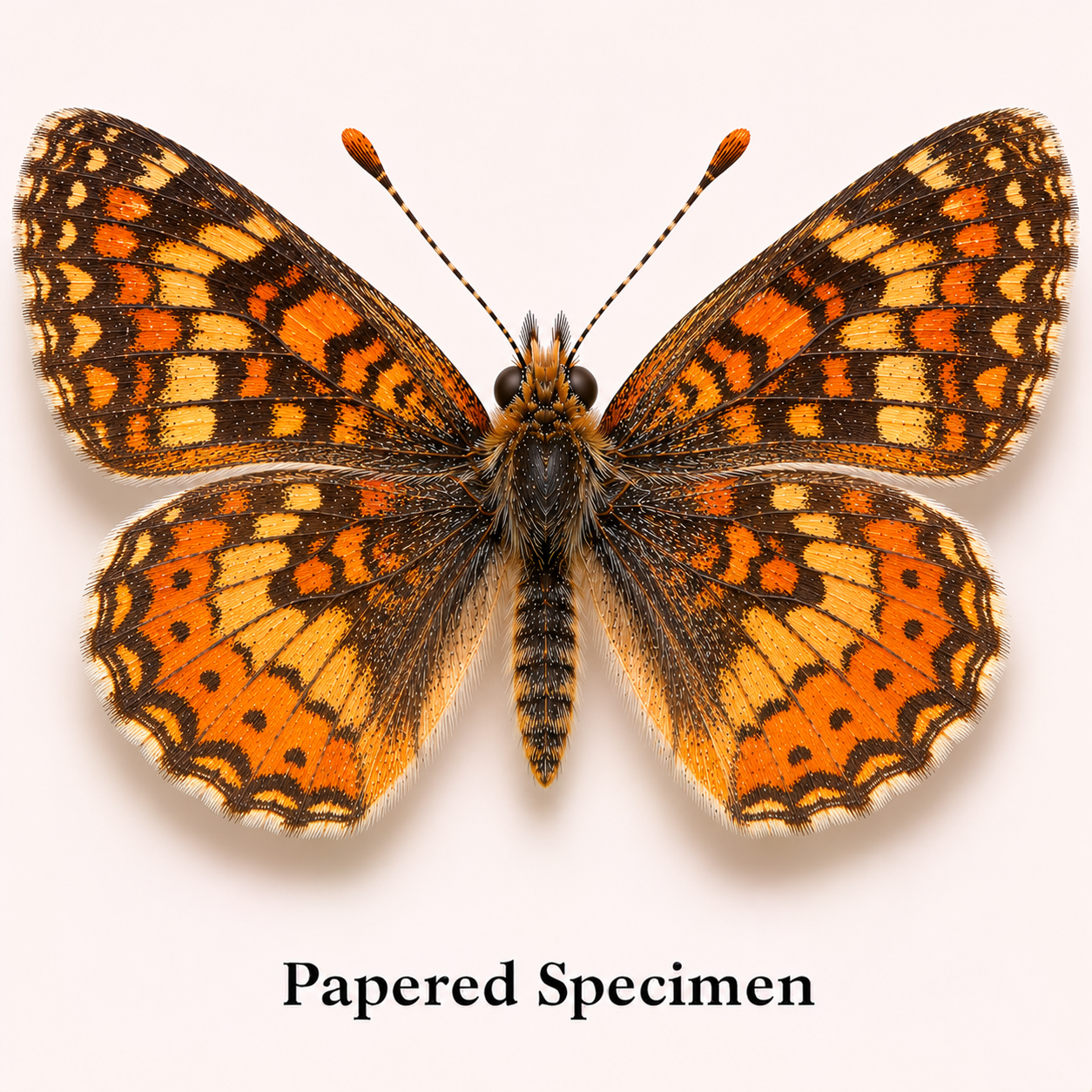
The California Crescent (Phyciodes orseis) is a beautiful North American butterfly recognized for its distinctive dark brown wings accented by bands of reddish-orange markings. The upper wings feature intricate patterns of orange-brown spots and dark borders, while the undersides display yellowish-orange coloration with scattered reddish-brown markings. With a wingspan of approximately 1¼ to 1⅝ inches, this member of the Nymphalidae family is one of the less commonly encountered crescent butterflies of western North America.
Native to western North America, Phyciodes orseis ranges from southern Oregon through northern and central California, extending into western Nevada. It inhabits mountain valleys, open woodlands, forest clearings, meadows, and stream canyons, particularly in areas with abundant thistles. Its caterpillars feed primarily on native and introduced thistles (Cirsium spp.) in the sunflower family (Asteraceae). Adults visit various wildflowers for nectar and are frequently observed along woodland trails and mountain streams.
Interesting Fact:
The California Crescent is considered an uncommon and locally distributed butterfly that can be difficult to distinguish from closely related species, particularly the Mylitta Crescent (Phyciodes mylitta). Its similar coloration and overlapping habitats can make identification challenging even for experienced butterfly enthusiasts. Unlike the Mylitta Crescent, which can produce multiple generations annually, the California Crescent typically produces only one generation each year. Females lay clusters of eggs on the undersides of thistle leaves, and the developing caterpillars survive winter in dormancy during their third growth stage. This species is of particular conservation interest because some populations have declined, and it may have disappeared from portions of California’s coastal ranges.
This specimen is preserved and is carefully stored in a protective paper triangle, ensuring it arrives safely and is ready for spreading or long-term collection. Collection data is included.
All specimens are ethically sourced, collected responsibly with a focus on sustainability and minimal impact on wild populations.
Image is a representation drawing and is not scientifically accurate.