
 Image 1 of 1
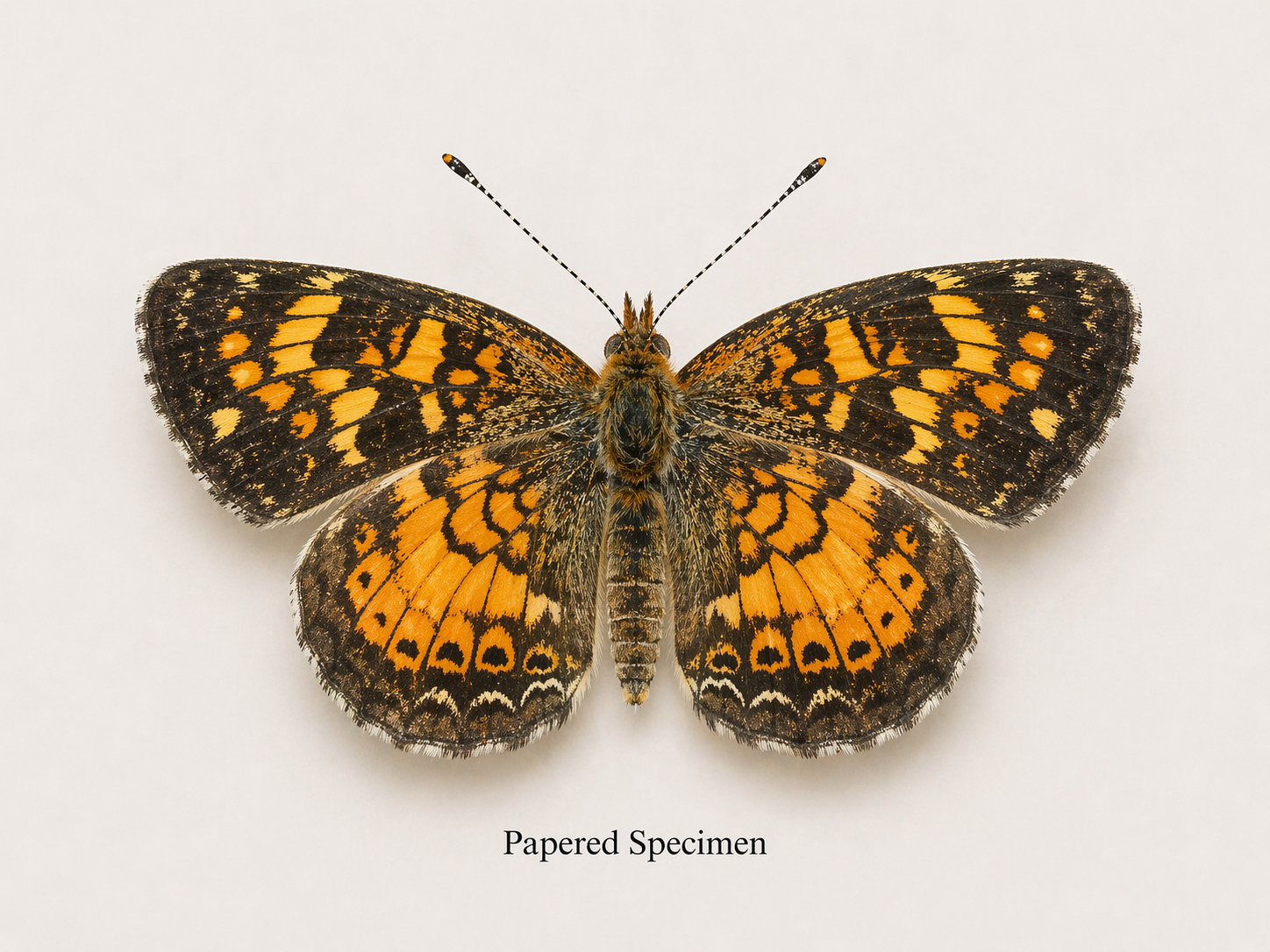
The Northern Crescent (Phyciodes selenis) is a small but striking butterfly with bright orange wings marked by bold black patterning. The underside is paler with intricate crescent-shaped markings, giving this species its common name.
Native to northern North America, Phyciodes selenis is found across Canada and into the northern United States, where it inhabits open areas such as meadows, woodland edges, and fields.
Interesting Fact:
This species belongs to a group of very similar crescent butterflies that can be difficult to separate, and its classification has been debated, making it especially interesting to collectors and lepidopterists.
This specimen is preserved and is carefully stored in a protective paper triangle, ensuring it arrives safely and is ready for spreading or long-term collection. Collection data is included.
All specimens are ethically sourced, collected responsibly with a focus on sustainability and minimal impact on wild populations.
Image is a representation drawing and is not scientifically accurate.
The Northern Crescent (Phyciodes selenis) is a small but striking butterfly with bright orange wings marked by bold black patterning. The underside is paler with intricate crescent-shaped markings, giving this species its common name.
Native to northern North America, Phyciodes selenis is found across Canada and into the northern United States, where it inhabits open areas such as meadows, woodland edges, and fields.
Interesting Fact:
This species belongs to a group of very similar crescent butterflies that can be difficult to separate, and its classification has been debated, making it especially interesting to collectors and lepidopterists.
This specimen is preserved and is carefully stored in a protective paper triangle, ensuring it arrives safely and is ready for spreading or long-term collection. Collection data is included.
All specimens are ethically sourced, collected responsibly with a focus on sustainability and minimal impact on wild populations.
Image is a representation drawing and is not scientifically accurate.