
 Image 1 of 1
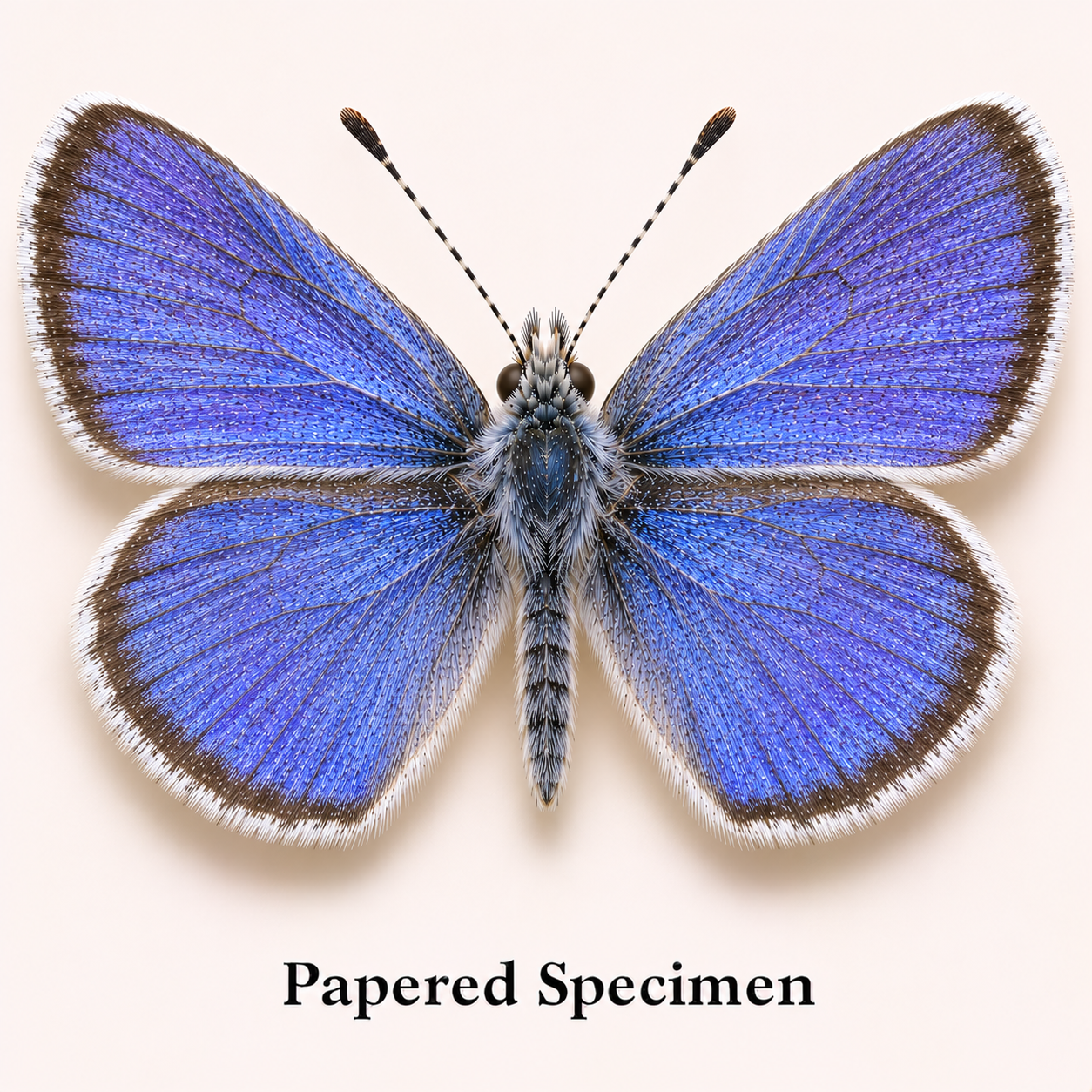
The Melissa Blue (Plebejus melissa) is a beautiful North American butterfly recognized for its brilliant violet-blue wings and distinctive orange and black markings. Males display shimmering blue upper wings bordered by narrow black margins and delicate white fringes, while females are predominantly brown with a row of bright orange crescents along the outer wing margins. The undersides are pale grayish-brown with numerous black spots, a prominent row of orange markings, and iridescent blue-green scales near the hindwing edges. With a wingspan of approximately ⅞ to 1⅜ inches, this member of the Lycaenidae family is a striking representative of western North America’s blue butterflies.
Native to North America, Plebejus melissa occurs throughout the Intermountain West, from southern Canada through the western United States and into northern Baja California, extending eastward into portions of the Great Plains. It inhabits open grasslands, mountain meadows, prairies, agricultural fields, roadsides, and other sunny environments with abundant flowering plants. Its caterpillars feed primarily on legumes in the pea family (Fabaceae), including lupines (Lupinus spp.), milkvetches (Astragalus spp.), and alfalfa (Medicago sativa). Adults visit a variety of wildflowers for nectar, particularly asters, buckwheats, and thistles.
Interesting Fact:
The Melissa Blue has a fascinating relationship with ants. Its caterpillars produce sugary secretions that attract ants, which tend the caterpillars and may help protect them from predators and parasites. This mutually beneficial relationship is known as myrmecophily and occurs in numerous species of blue butterflies. Another remarkable characteristic of the Melissa Blue is its ability to adapt to introduced plants. Some western populations have developed the ability to feed and reproduce on cultivated alfalfa, an agricultural crop introduced from Eurasia. This adaptation has made the species an important subject of evolutionary research. Unlike many butterflies that produce only one generation annually, western Melissa Blues may produce as many as three generations during the warmer months, with adults flying from spring through early autumn.
This specimen is preserved and is carefully stored in a protective paper triangle, ensuring it arrives safely and is ready for spreading or long-term collection. Collection data is included.
All specimens are ethically sourced, collected responsibly with a focus on sustainability and minimal impact on wild populations.
Image is a representation drawing and is not scientifically accurate.