
 Image 1 of 1
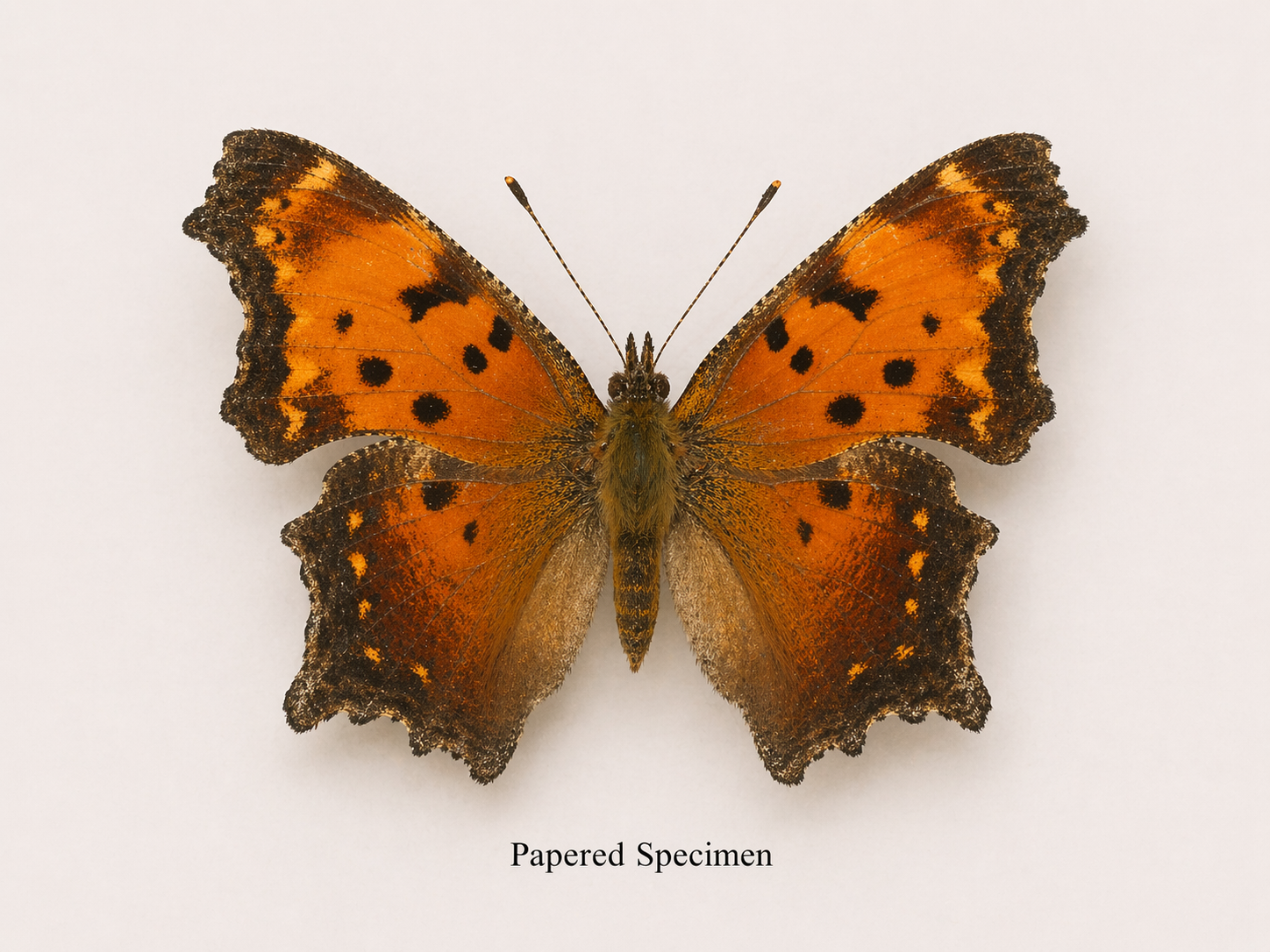
The Gray Comma (Polygonia progne) is a distinctive butterfly with ragged, angular wing edges and a mottled brown and orange coloration. The underside of the wings resembles bark or dead leaves, providing excellent camouflage, while a small silver comma-shaped mark gives the species its name.
Native to North America, Polygonia progne is found across much of the northern United States and southern Canada. It is commonly associated with open woodlands, forest edges, and areas where its host plants grow.
Interesting Fact:
This species often overwinters as an adult, hiding in tree bark or leaf litter and emerging early in spring—sometimes one of the first butterflies seen after winter.
This specimen is preserved and is carefully stored in a protective paper triangle, ensuring it arrives safely and is ready for spreading or long-term collection. Collection data is included.
All specimens are ethically sourced, collected responsibly with a focus on sustainability and minimal impact on wild populations.
Image is a representation drawing and is not scientifically accurate.
The Gray Comma (Polygonia progne) is a distinctive butterfly with ragged, angular wing edges and a mottled brown and orange coloration. The underside of the wings resembles bark or dead leaves, providing excellent camouflage, while a small silver comma-shaped mark gives the species its name.
Native to North America, Polygonia progne is found across much of the northern United States and southern Canada. It is commonly associated with open woodlands, forest edges, and areas where its host plants grow.
Interesting Fact:
This species often overwinters as an adult, hiding in tree bark or leaf litter and emerging early in spring—sometimes one of the first butterflies seen after winter.
This specimen is preserved and is carefully stored in a protective paper triangle, ensuring it arrives safely and is ready for spreading or long-term collection. Collection data is included.
All specimens are ethically sourced, collected responsibly with a focus on sustainability and minimal impact on wild populations.
Image is a representation drawing and is not scientifically accurate.