
 Image 1 of 1
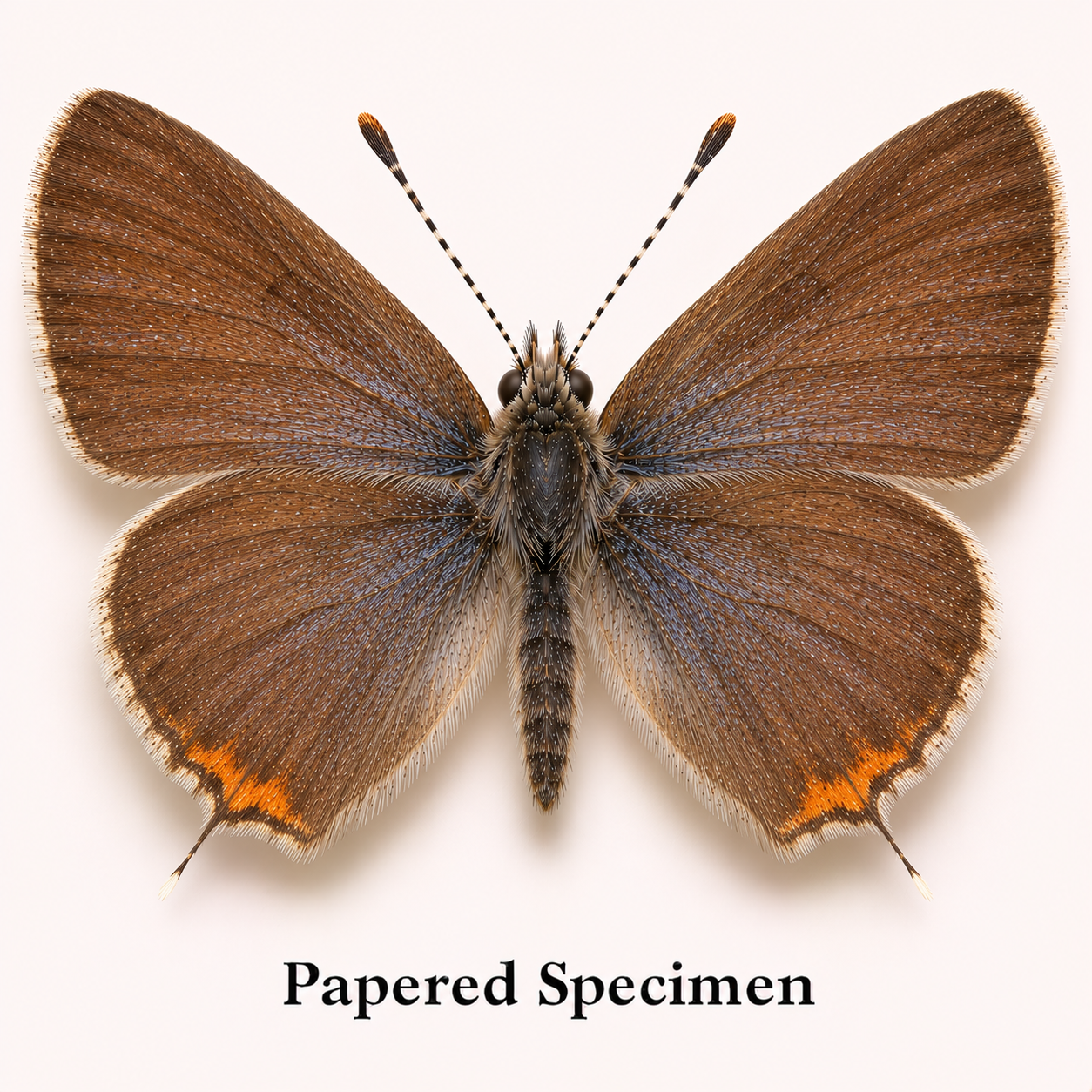
The Sylvan Hairstreak (Satyrium sylvinus) is a beautiful North American butterfly recognized for its delicate grayish-brown wings, subtle reddish-orange markings, and distinctive blue accents near the hindwing margins. The upper wings are typically gray-brown to reddish-brown, sometimes displaying a faint bluish sheen, while the undersides are pale gray to nearly white with a delicate row of small black spots. The hindwings feature orange markings and may have slender, hairlike tails, although some populations are naturally tailless. With a wingspan of approximately 1 to 1⅜ inches, this member of the Lycaenidae family is a distinctive butterfly of western North America’s riparian habitats.
Native to western North America, Satyrium sylvinus ranges from southern British Columbia through Washington, Oregon, and California into northern Baja California, extending eastward into Wyoming, Colorado, and New Mexico. It inhabits willow thickets, riparian woodlands, mountain meadows, stream corridors, and open forests, particularly near rivers and other water sources. Its caterpillars feed primarily on willows (Salix spp.), with different populations utilizing different willow species. Adults visit a variety of flowering plants for nectar, including milkweeds, dogbane, wild buckwheats, and yarrow.
Interesting Fact:
The Sylvan Hairstreak exhibits remarkable variation in appearance, with some populations possessing distinct hindwing tails while others lack them entirely. Its wing coloration and markings also vary considerably between populations, making identification challenging. Females lay individual eggs on willow stems, where the developing butterflies remain dormant throughout winter before hatching the following spring. This species produces only one generation annually, with adults typically appearing from late spring through summer. Interestingly, researchers at the University of California, Davis, have documented a dramatic decline in Sylvan Hairstreak populations in California’s Sacramento Valley. Once extraordinarily abundant during the 1970s, this butterfly has become increasingly scarce in many areas where it was formerly common, despite the continued presence of suitable willow host plants.
This specimen is preserved and is carefully stored in a protective paper triangle, ensuring it arrives safely and is ready for spreading or long-term collection. Collection data is included.
All specimens are ethically sourced, collected responsibly with a focus on sustainability and minimal impact on wild populations.
Image is a representation drawing and is not scientifically accurate.