
 Image 1 of 1
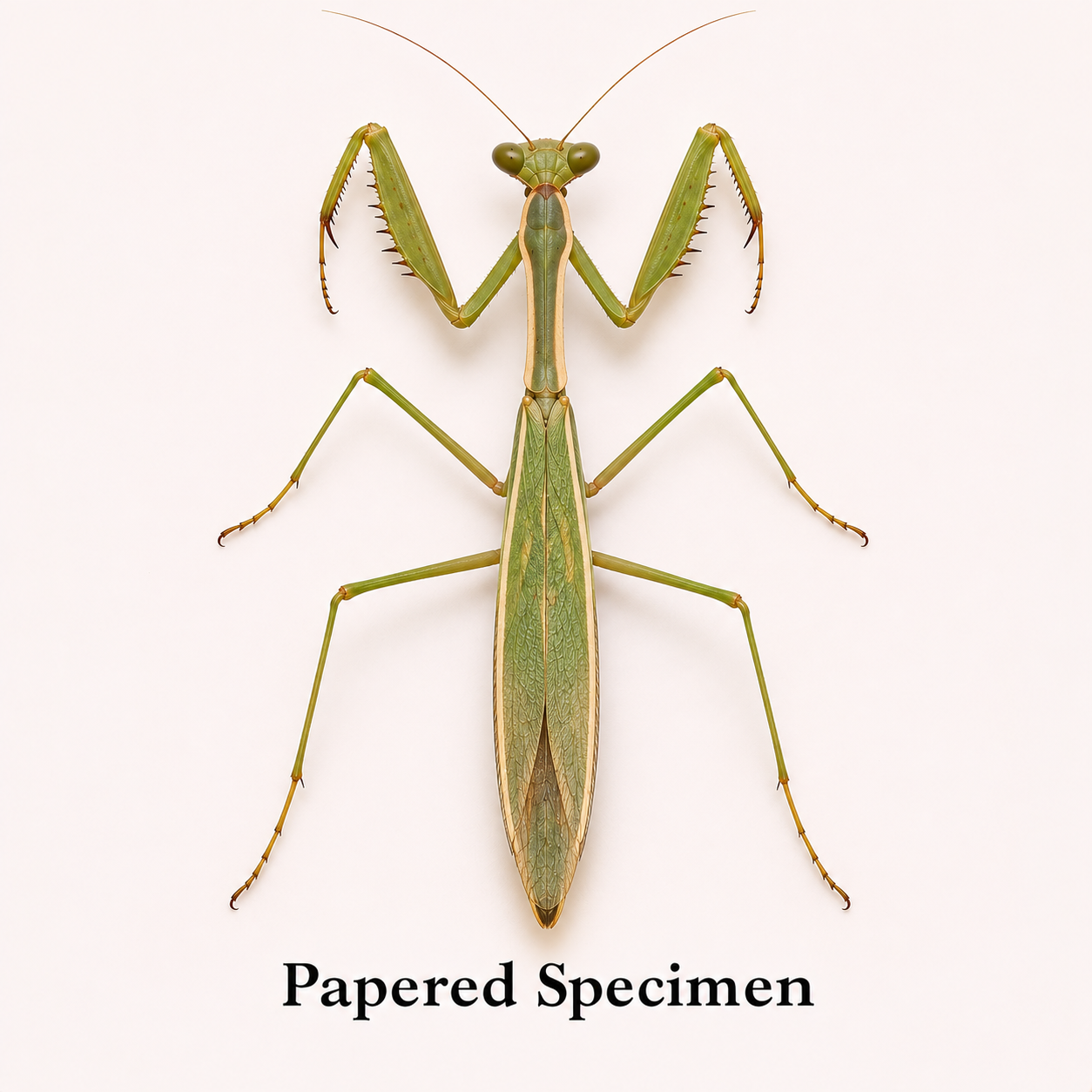
The Bordered Mantis (Stagmomantis limbata) is a fascinating North American praying mantis recognized for its elongated body, triangular head, and powerful grasping forelegs. Its coloration ranges from bright green to tan and brown, providing excellent camouflage among leaves, grasses, and branches. The species displays pronounced sexual dimorphism, with females possessing larger, more robust bodies and shorter wings, while males are smaller, slender, and capable of flight. Adults can reach approximately 2 to 3 inches in length. This member of the Mantidae family is one of the distinctive native praying mantises of the southwestern United States.
Native to North America, Stagmomantis limbata occurs throughout the southwestern United States, including California, Arizona, New Mexico, Texas, Utah, and Colorado, with its distribution extending south into Mexico and parts of Central America. It inhabits grasslands, desert scrub, chaparral, open woodlands, gardens, and areas with abundant flowering vegetation. Both adults and immature mantises are ambush predators, feeding on a wide variety of insects, including flies, moths, butterflies, bees, and grasshoppers. They rely on their exceptional camouflage and rapid strikes to capture unsuspecting prey.
Interesting Fact:
The Bordered Mantis possesses remarkable hunting adaptations, including a highly mobile triangular head that can rotate approximately 180 degrees and specialized raptorial forelegs lined with sharp spines. These adaptations allow it to track moving prey and capture insects with extraordinary speed. Females are generally flightless and release chemical signals called pheromones to attract flying males. Although sexual cannibalism can occur, females do not need to consume males to reproduce. After mating, females deposit their eggs inside a hardened, foamlike protective case called an ootheca, which is typically attached to branches or other solid surfaces. The eggs survive winter inside this protective structure, and numerous tiny mantis nymphs emerge the following spring. Interestingly, scientific studies have demonstrated that larger females can capture a wider range of prey sizes and generally produce more eggs than smaller females.
This specimen is preserved and is carefully stored in a protective paper triangle, ensuring it arrives safely and is ready for spreading or long-term collection. Collection data is included.
All specimens are ethically sourced, collected responsibly with a focus on sustainability and minimal impact on wild populations.
Image is a representation drawing and is not scientifically accurate.