
 Image 1 of 1
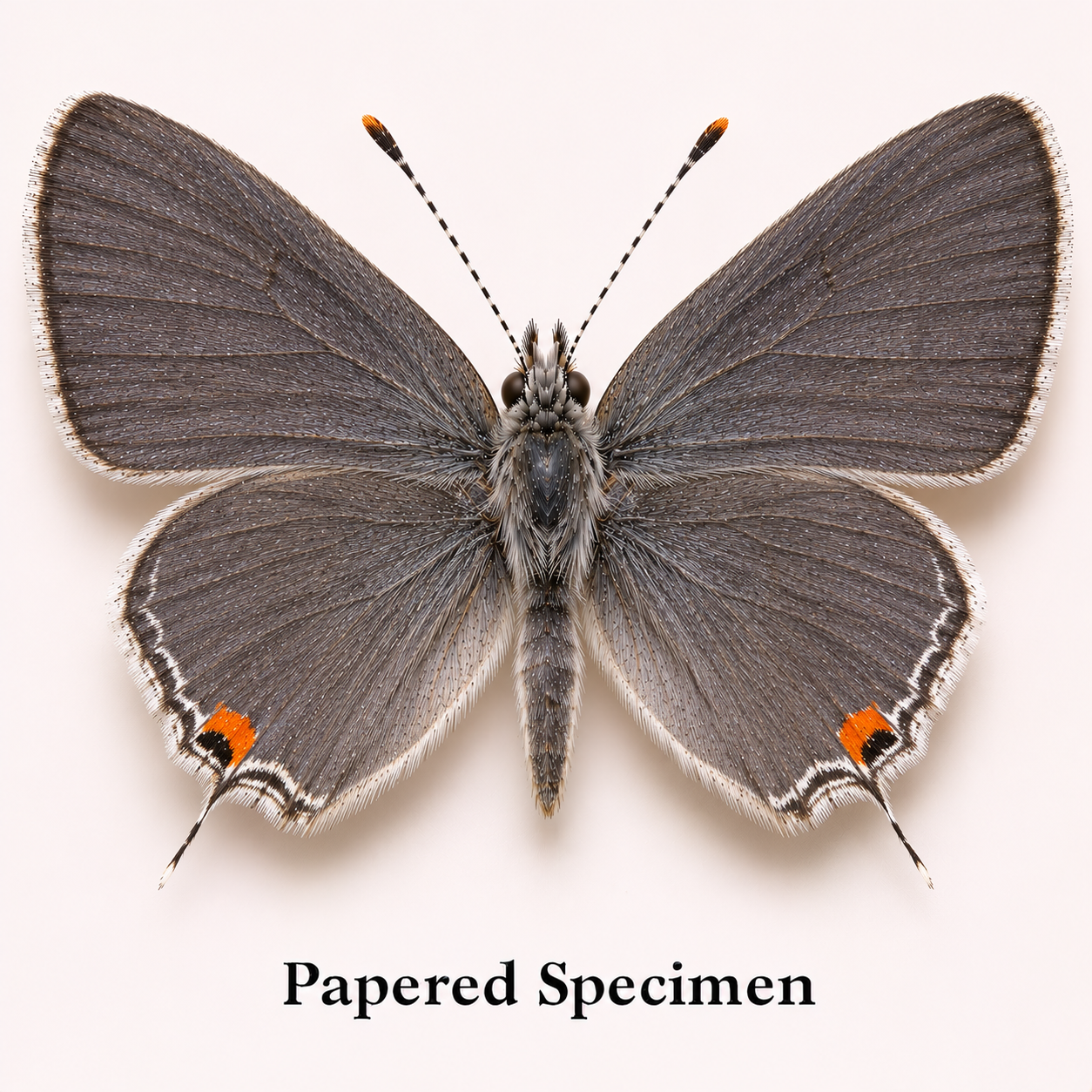
The Gray Hairstreak (Strymon melinus) is a beautiful North American butterfly recognized for its delicate bluish-gray wings, intricate white and black markings, and distinctive reddish-orange spots near the hindwing margins. The upper wings are predominantly slate-gray with subtle blue tones, while the undersides display soft gray coloration crossed by thin white lines bordered with orange. Each hindwing features a slender, hairlike tail and a prominent orange-and-black eyespot. With a wingspan of approximately ⅞ to 1⅜ inches, this member of the Lycaenidae family is one of the most widespread and recognizable hairstreak butterflies in North America.
Native to North and South America, Strymon melinus ranges from southern Canada throughout the continental United States, Mexico, and Central America, extending south into Venezuela. It inhabits grasslands, open woodlands, meadows, gardens, agricultural fields, roadsides, and disturbed areas with abundant flowering vegetation. Its caterpillars feed on an exceptionally wide variety of plants, particularly members of the pea family (Fabaceae) and mallow family (Malvaceae), including clovers (Trifolium spp.), alfalfa (Medicago sativa), beans (Phaseolus spp.), and mallows (Malva spp.). Adults visit numerous wildflowers for nectar, including milkweeds, dogbane, goldenrods, and mints.
Interesting Fact:
The Gray Hairstreak possesses a remarkable defense mechanism designed to confuse predators. Its slender hindwing tails resemble antennae, while the nearby orange-and-black markings create the appearance of a second head. When resting, the butterfly frequently rubs its hindwings together, causing the false antennae to move and potentially drawing a predator’s attack toward the less vulnerable rear of its wings rather than its actual head. This species is also one of the most adaptable butterflies in North America, with caterpillars capable of feeding on plants from numerous botanical families. Females lay individual eggs on the flowers and developing fruits of host plants, where young caterpillars begin feeding before occasionally moving onto leaves. Gray Hairstreaks produce multiple generations annually, with adults sometimes remaining active from February through November in California’s warmer regions. They generally survive winter in the chrysalis stage.
This specimen is preserved and is carefully stored in a protective paper triangle, ensuring it arrives safely and is ready for spreading or long-term collection. Collection data is included.
All specimens are ethically sourced, collected responsibly with a focus on sustainability and minimal impact on wild populations.
Image is a representation drawing and is not scientifically accurate.