
 Image 1 of 1
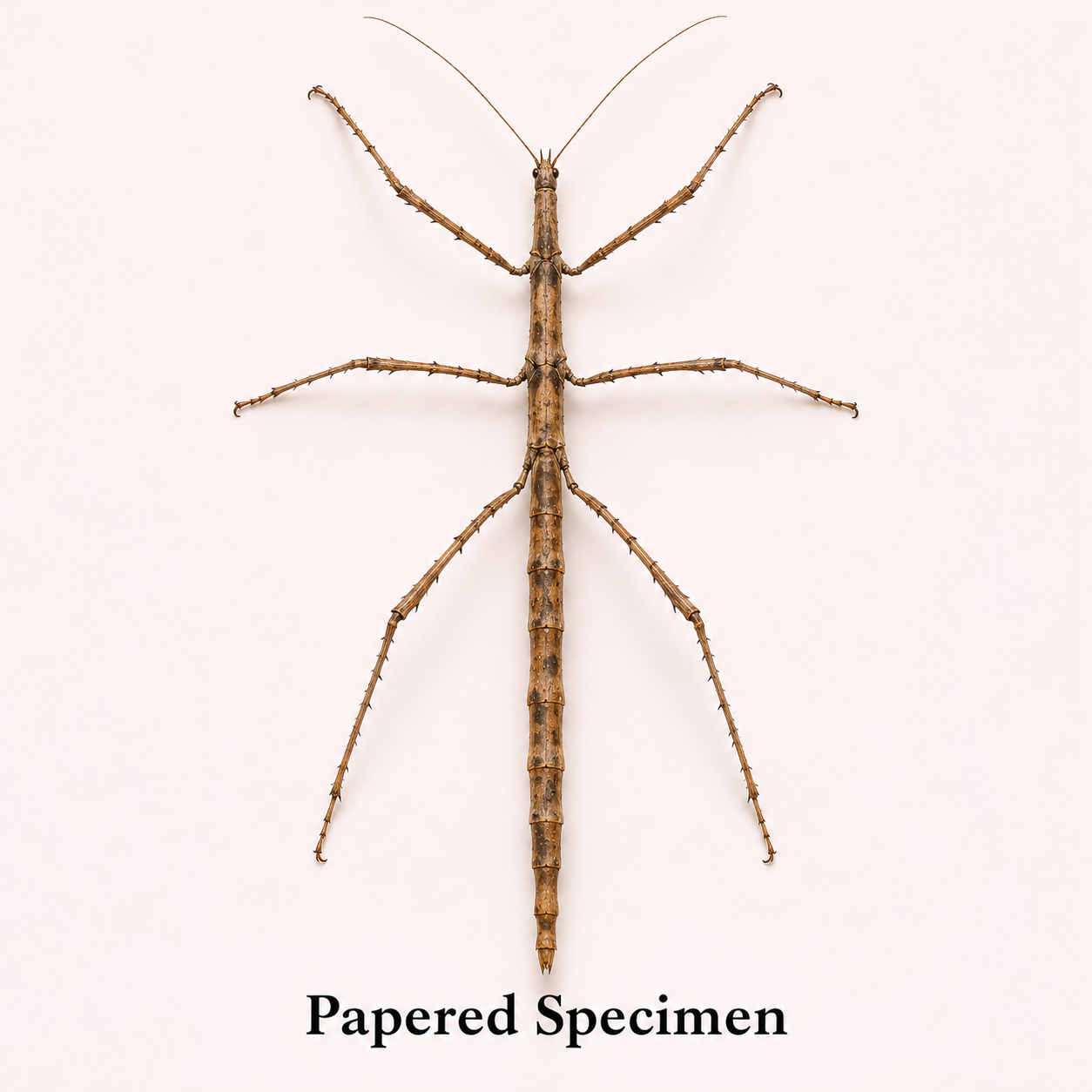
The Giant Stick Insect (Tirachoidea westwoodii) is a remarkable Asian insect recognized for its extraordinary length, slender body, and exceptional resemblance to branches and twigs. Its elongated body displays natural shades of brown and green that help it blend into surrounding vegetation. Females are especially impressive, with documented specimens measuring approximately 9¼ inches in body length, not including their extended legs. This member of the Phasmatidae family belongs to the order Phasmatodea, a group of insects celebrated for their remarkable camouflage.
Native to tropical and subtropical regions of Asia, Tirachoidea westwoodii occurs in northeastern India, Myanmar, Thailand, and Vietnam. It inhabits forests and wooded environments, where its elongated body and slender legs provide effective camouflage among branches and foliage. Like other stick insects, it is herbivorous, feeding on leaves rather than other insects. Its primarily nocturnal habits help it remain concealed from predators during daylight hours.
Interesting Fact:
The Giant Stick Insect possesses one of nature’s most remarkable camouflage adaptations. By remaining motionless with its legs aligned alongside its body, it can closely resemble a slender branch. Stick insects may also sway gently from side to side, a behavior that helps them resemble vegetation moving in the breeze. Another fascinating characteristic of Tirachoidea westwoodii is the structure of its eggs. Scientific research has shown that their protective shells contain calcium carbonate and calcium oxalate, creating a remarkably tough outer covering. The species was originally described by James Wood-Mason in 1875, but its males were not formally described in detail until a major scientific revision published in 2008. This unusual history reflects how much remains to be discovered about even some of the world’s largest insects.
This specimen is preserved and is carefully stored in a protective paper triangle, ensuring it arrives safely and is ready for spreading or long-term collection. Collection data is included.
All specimens are ethically sourced, collected responsibly with a focus on sustainability and minimal impact on wild populations.
Image is a representation drawing and is not scientifically accurate.