
 Image 1 of 1
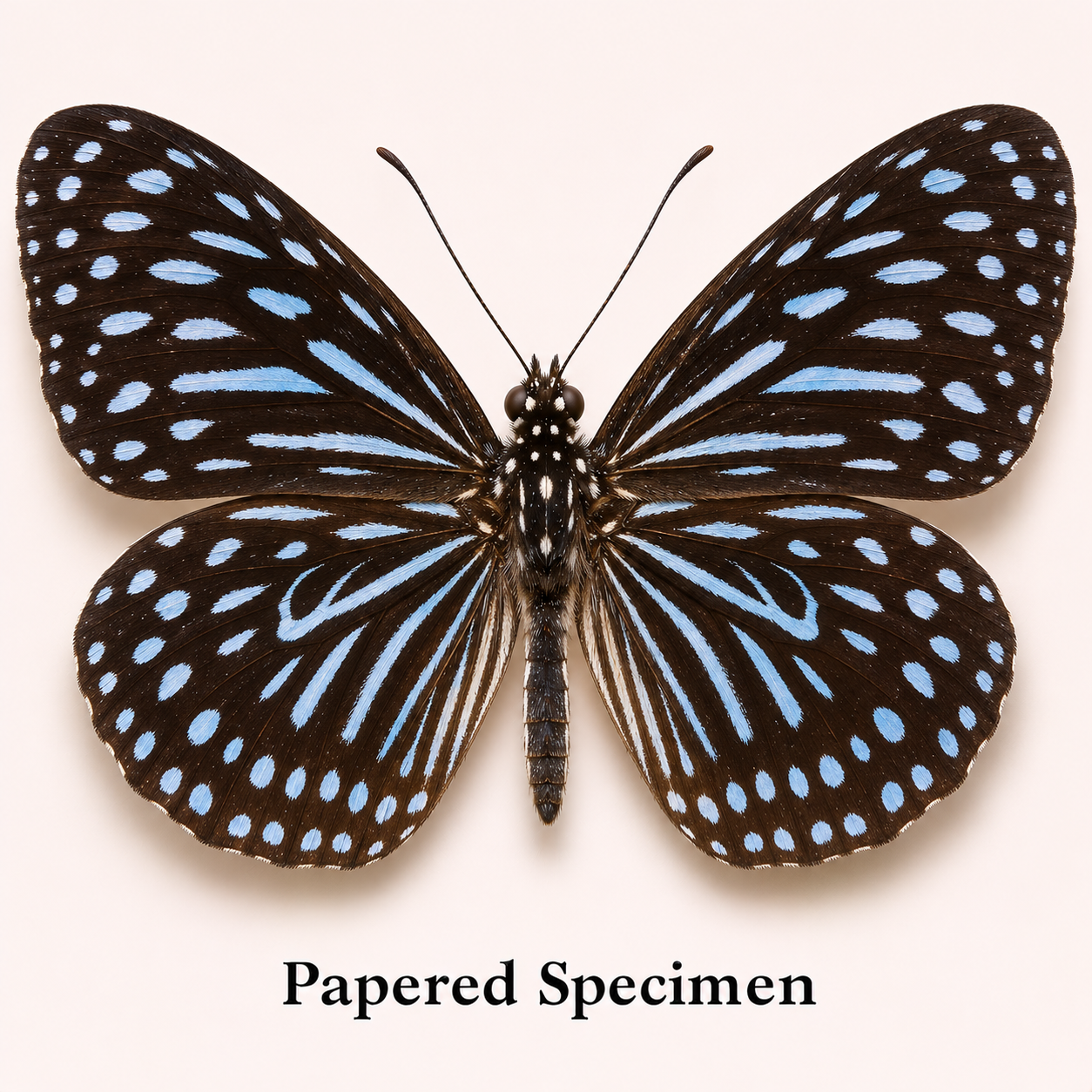
The Dark Blue Tiger (Tirumala septentrionis) is a beautiful Asian butterfly recognized for its striking dark brown to nearly black wings decorated with intricate pale blue and bluish-white streaks and spots. The elongated forewings display narrow, translucent blue markings, while the hindwings feature a distinctive arrangement of rounded spots and elongated streaks. Its contrasting coloration creates an elegant pattern that is especially striking when the wings are fully spread. With a wingspan of approximately 2¾ to 3½ inches, this member of the Nymphalidae family belongs to the milkweed butterfly subfamily Danainae.
Native to South and Southeast Asia, Tirumala septentrionis occurs throughout India, Sri Lanka, Nepal, Bhutan, Myanmar, Thailand, Malaysia, and other parts of tropical Asia. It inhabits tropical forests, open woodlands, forest edges, gardens, and areas with abundant flowering vegetation. Its caterpillars feed on plants in the dogbane family (Apocynaceae), including Wattakaka volubilis, Vallaris species, and other climbing vines. Adults visit a variety of flowering plants for nectar and are frequently observed gliding slowly through forest clearings and along woodland edges.
Interesting Fact:
The Dark Blue Tiger is particularly fascinating for its remarkable seasonal migrations. In southern India, large numbers of these butterflies participate in mass migrations associated with the monsoon, sometimes traveling alongside other milkweed butterflies, including the Blue Tiger and Common Crow. During these movements, hundreds or thousands of butterflies may gather in communal resting groups, creating spectacular displays of blue and black wings. Like many other milkweed butterflies, the Dark Blue Tiger uses chemical defenses associated with its larval host plants to discourage predators. Males also possess specialized scent-producing structures on their hindwings that play a role in courtship. This species can produce multiple generations annually in favorable tropical conditions.
This specimen is preserved and is carefully stored in a protective paper triangle, ensuring it arrives safely and is ready for spreading or long-term collection. Collection data is included.
All specimens are ethically sourced, collected responsibly with a focus on sustainability and minimal impact on wild populations.
Image is a representation drawing and is not scientifically accurate.