
 Image 1 of 1
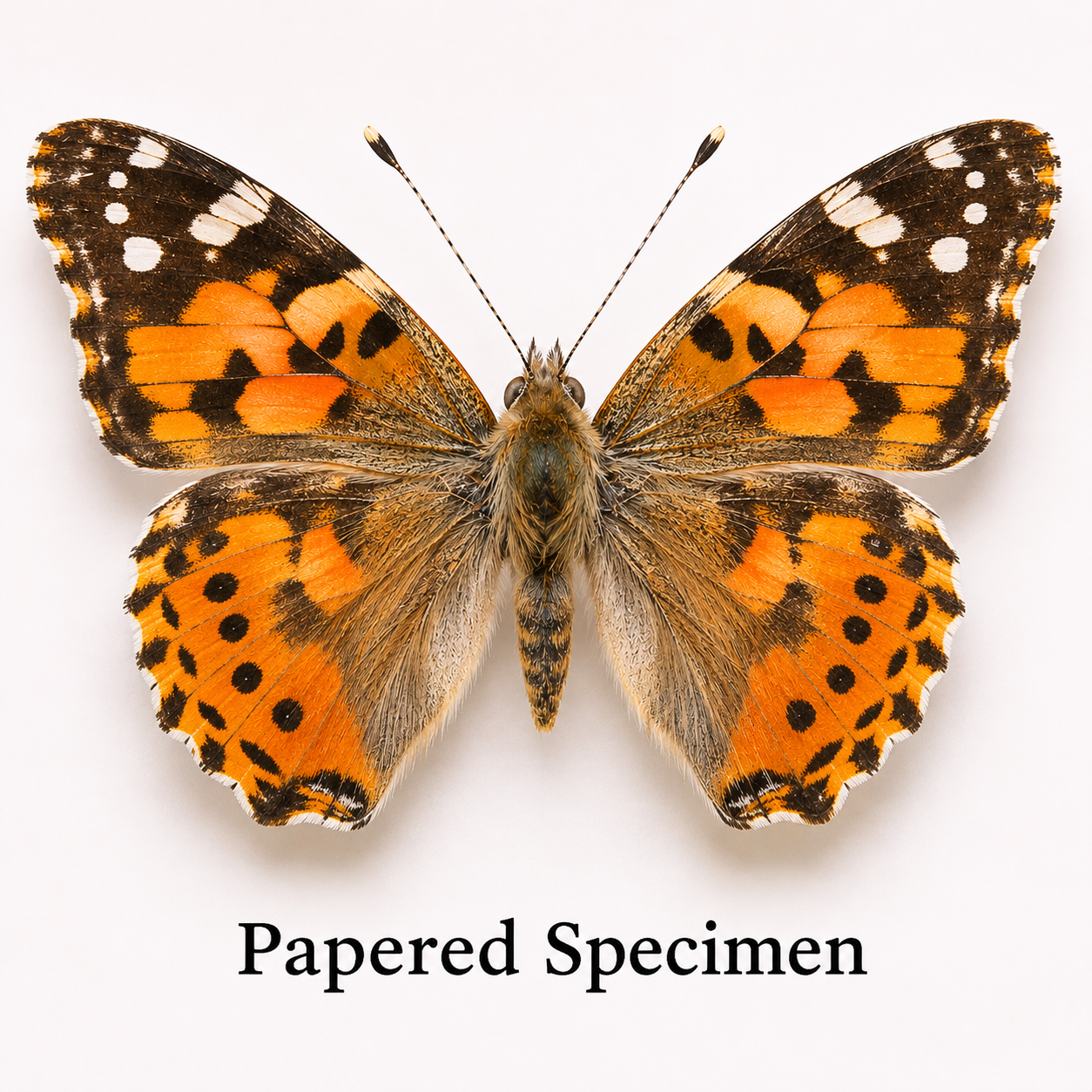
The Painted Lady (Vanessa cardui) is a beautiful butterfly recognized for its vibrant orange-brown wings decorated with bold black markings and distinctive white spots near the forewing tips. The upper wings feature intricate patterns of orange, black, and cream, while the undersides display delicate mottled shades of brown, gray, and tan. The hindwing undersides are especially distinctive, featuring four small eyespots that help distinguish this species from similar butterflies. With a wingspan of approximately 2 to 2⅞ inches, this member of the Nymphalidae family is one of the most widespread and recognizable butterflies in the world.
Found across much of the world, Vanessa cardui occurs throughout North America, Europe, Africa, Asia, and numerous islands. It inhabits grasslands, meadows, deserts, open woodlands, gardens, roadsides, and agricultural fields. Its caterpillars feed on an exceptionally wide variety of plants, particularly thistles (Cirsium spp.), mallows (Malva spp.), and hollyhocks (Alcea spp.). Adults visit numerous wildflowers for nectar, including thistles, asters, milkweeds, clovers, and goldenrods.
Interesting Fact:
The Painted Lady is famous for its extraordinary long-distance migrations, which can involve millions or even billions of butterflies. In western North America, particularly large migrations occur following unusually wet winters in the deserts of northern Mexico and the southwestern United States. When abundant rainfall produces extensive growth of caterpillar host plants, enormous numbers of butterflies emerge and migrate northward through California and neighboring states. During exceptional migration years, so many butterflies may cross highways and communities that they become a remarkable natural spectacle. Painted Ladies also undertake multigenerational migrations between Africa and Europe, with successive generations continuing journeys that individual butterflies cannot complete alone. Unlike many butterflies that survive winter in a dormant stage, Painted Ladies generally avoid prolonged freezing conditions by migrating or reproducing in warmer regions. Their remarkable adaptability and ability to utilize more than 100 different caterpillar host plants have helped make them one of the most successful butterfly species on Earth.
This specimen is preserved and is carefully stored in a protective paper triangle, ensuring it arrives safely and is ready for spreading or long-term collection. Collection data is included.
All specimens are ethically sourced, collected responsibly with a focus on sustainability and minimal impact on wild populations.
Image is a representation drawing and is not scientifically accurate.