
 Image 1 of 1
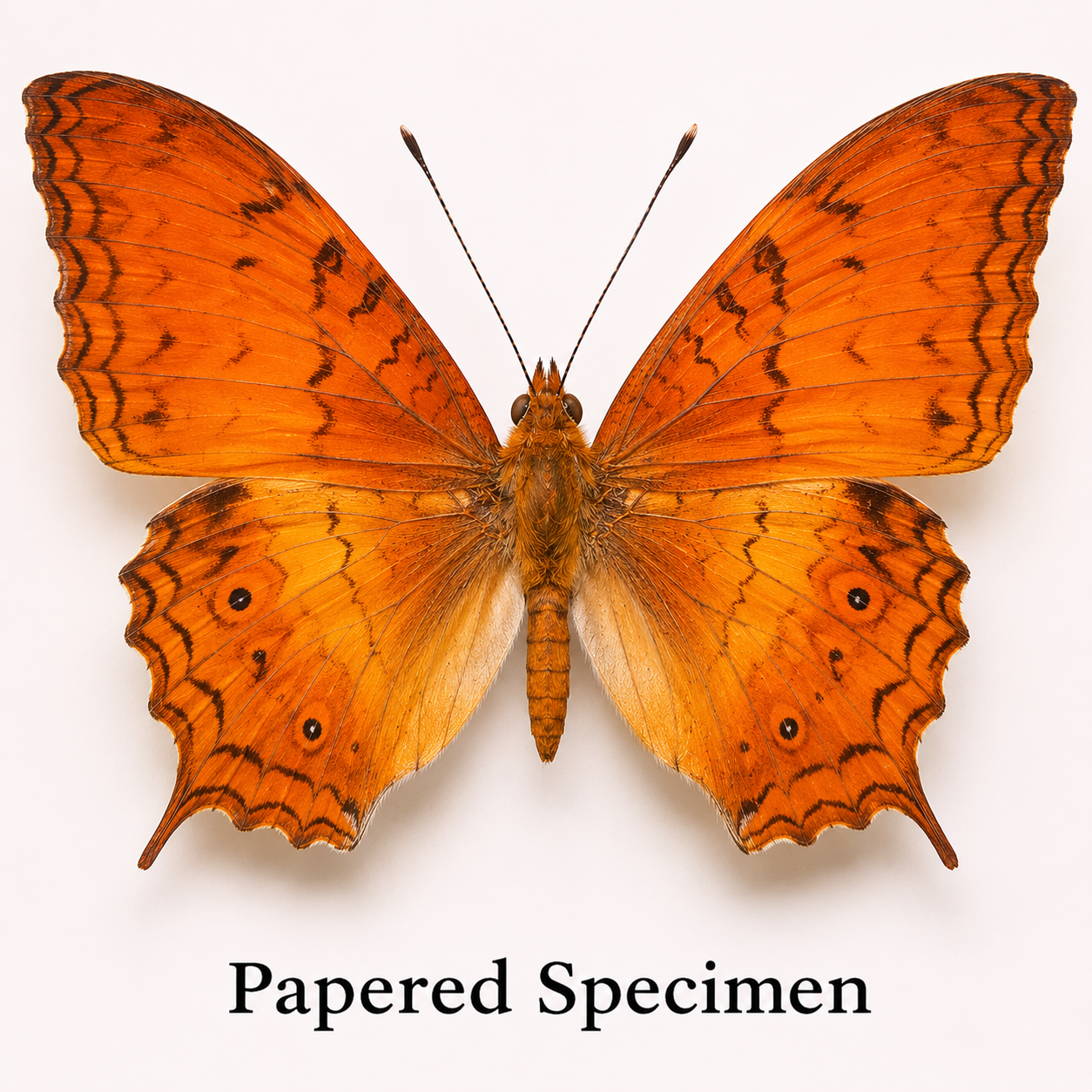
The Malay Cruiser (Vindula dejone) is a magnificent Southeast Asian butterfly recognized for its striking coloration, elegant wing patterns, and remarkable differences between males and females. Males display brilliant golden-orange wings decorated with bold black markings, while females have pale greenish-gray to brown wings crossed by broad creamy-white bands. Both sexes feature distinctive eyespots near the hindwing margins and short, pointed tails. With a wingspan of approximately 2½ to 3¼ inches, this member of the Nymphalidae family belongs to the subfamily Heliconiinae.
Native to Southeast Asia, Vindula dejone occurs throughout Thailand, Malaysia, Singapore, Indonesia, and the Philippines. It inhabits tropical rainforests, forest edges, woodland clearings, riverbanks, and gardens, particularly in areas with abundant flowering vegetation. Its caterpillars feed on climbing vines in the passionflower family (Passifloraceae), including Adenia species and giant granadilla (Passiflora quadrangularis). Adults visit flowering plants for nectar, including lantana, and males frequently gather at damp ground to obtain dissolved minerals.
Interesting Fact:
The Malay Cruiser exhibits extraordinary sexual dimorphism, meaning males and females have dramatically different appearances. The brilliant orange males and subdued grayish-green females can look like entirely different species. Males are frequently observed engaging in a behavior called mud-puddling, during which they absorb moisture and minerals from damp soil, sometimes gathering at locations enriched with animal urine. The caterpillars possess numerous prominent spines along their bodies, giving them a formidable appearance. When they transform into chrysalises, their coloration and irregular shapes resemble dried leaves, providing camouflage against predators. The species also includes numerous geographically distinct subspecies distributed across Southeast Asia’s islands, reflecting the remarkable diversity of tropical butterflies.
This specimen is preserved and is carefully stored in a protective paper triangle, ensuring it arrives safely and is ready for spreading or long-term collection. Collection data is included.
All specimens are ethically sourced, collected responsibly with a focus on sustainability and minimal impact on wild populations.
Image is a representation drawing and is not scientifically accurate.