
 Image 1 of 1
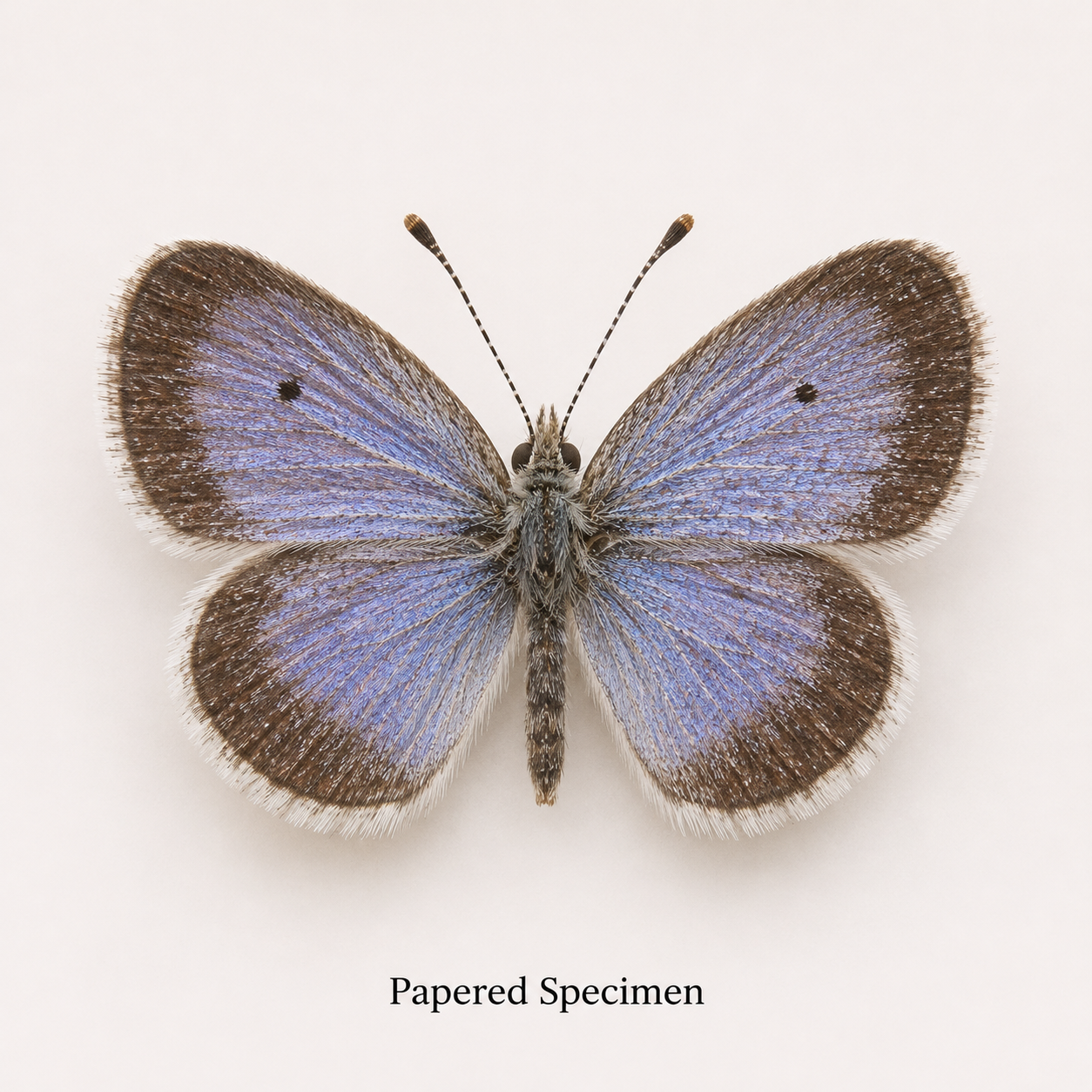
The Cyna Blue (Zizula cyna) is a beautiful miniature butterfly recognized for its delicate violet-blue wings and intricate markings. The upper wings display a soft violet-blue coloration bordered by broad dark margins, while the undersides are pale gray with numerous tiny black spots and distinctive zigzag markings near the outer edges. Its subtle coloration and exceptionally small size make it easy to overlook among surrounding vegetation. With a wingspan of approximately ⅝ to ⅞ inch, this member of the Lycaenidae family is among the smallest butterflies found in North America.
Native to the Americas, Zizula cyna ranges from southern Texas through Mexico and Central America into South America, reaching as far south as Argentina. It inhabits subtropical scrublands, desert vegetation, open grasslands, and other warm environments with suitable flowering plants. Its caterpillars feed primarily on the flower buds of plants in the acanthus family (Acanthaceae), including Dyschoriste species. Adults visit small flowers for nectar and are most commonly encountered in warm, sunny habitats.
Interesting Fact:
The Cyna Blue is remarkable for its exceptionally small size, rivaling the Western Pygmy-Blue as one of North America’s tiniest butterflies. Although established across much of its tropical and subtropical range, it is exceptionally uncommon in the United States outside southern Texas. Occasional individuals wander north into Arizona, New Mexico, and even Kansas. Remarkably, Cyna Blues have been recorded at elevations approaching 8,000 feet in New Mexico’s Sacramento Mountains, far beyond their usual lowland subtropical habitats. Their caterpillars have a specialized feeding preference for the flower buds of acanthus-family plants. Unlike many better-studied North American butterflies, the Cyna Blue’s complete life history and number of annual generations remain poorly documented, making it an especially interesting species for butterfly researchers and collectors.
This specimen is preserved and is carefully stored in a protective paper triangle, ensuring it arrives safely and is ready for spreading or long-term collection. Collection data is included.
All specimens are ethically sourced, collected responsibly with a focus on sustainability and minimal impact on wild populations.
Image is a representation drawing and is not scientifically accurate.